Showing posts with label Theatre. Show all posts

Saturday, June 2, 2012

"Mon panache." Cyrano de Bergerac and history.


Anyone who has read Shakespeare’s Richard III and then done some research quickly realises that the play and history don’t have all that much in common. And that’s fine. Shakespeare was above all a man of the theatre who knew what sold, and if the play itself is a bit clunky and long, the character of Richard is always a favourite with audiences, whether he’s medieval and silky like Olivier, gothic and spidery like Sher or modern and slick like Ewen Leslie in MTC’s 2010 production.

Cyrnano de Bergerac is another historical character best known for the play losely based on his life rather than for himself.  Ishbel Addeyman has made an effort to change all that with her 2010 book, Cyrano: The life and legend of Cyrano de Bergerac. She insists that the real Cyrano is even more fascinating than the character. Sadly, she never quites proves it.

Not that Cyrano is without interest. He was a skilled swordsman, and did indeed fight 100 men at once. So the story at the time had it, even if there was no proof of it beyond nine hats lost by the attackers. Still, even if it was one against nine, that’s still a good effort tough to equal. He was a writer and satirist, inventing science fiction, parodying 17th century French society with his tales of journeys to the Moon and to the Sun and the people he finds there. He had enemies who in the end murdered him – all by the age of thirty-six.

Addeyman goes further than the legend.  His cousin Roxanne was older than he, and it seems of no romantic interest. Indeed, Addyman thinks it likely that he was gay, with intense friendships and fight with certain male friends as her evidence. Certainly it seems he was never involved in a great heterosexual romance so who knows. It certainly would have made him even more an outsider in his society.

As did his atheism. At the time atheism was as daring and dangerous as some people seem to think it is now.  But she harms this finding by the sheer weight she puts on it. Having establlished this fact, she cannot leave it alone. Everything leads back to his atheism. In one chapter she starts talking about a mystery wound he has. This only holds her interest for a few pages before she’s back to his atheism. Too much of this book feels like filler and much of this filler is this.  She even claims the Jesuits killed him. Not with any evidence or anything, but he was atheist and Jesuits get up to stuff so you know, it stands to reason.

Which is a pity. There is some good stuff on the role of duelling in France and Cyrano’s attitude towards it, and violence as his life went on. His literary fights with his rivals are also good. He had difficult relations with his family, and would change his name to create a more aristocratic background than his suburban Parisian one.  Towards the end, he did indeed find a patron; one that abandoned him after the attack that wounded and eventually killed Cyrano. And he was proud of his large nose. All his portraits show him posing at an angle that emphasised it. I would have liked to read more about the man and less about the one, admittedly interesting aspect of him, that of his religious beliefs or lack thereof. But perhaps she has the same challenge that Shakespeare’s biographers have – there just isn’t that much material. Le Bret wrote a biography and there is his own writing and letters, but the rest is supposition and inference. Addyman may rely too much on this for mine.

She also makes one odd, glaring error. One of Cyrano’s pet hates was plagiarism, and so she thinks it is ironic that his fame rests on a play based on plagiarism. Cyrano giving Christian his lines to speak to Roxanne is not plagiarism, it’s playwrighting. She seems unsure of the meaning of ‘irony’ and ‘plagiarism’. Mind you, as Brisbane friends know, she’s not alone. However, she’s on stronger ground when she reveals that the play itself was banned from the US for fifty years, on charges of plagiarism. Rostand had read a play with the central device of the friend giving another his lines to woo a woman. His play was better but the charge stuck. And yes, Moliere did steal the“what the devil was he doing there?” scene lock stock and barrel from Cyrano.

But in the end, this is a rather dull book, which is a pity. The historical Cyrano and his writing do deserve to be better known than they are. But in the meanwhile, we could all do a lot worse than be commemorated in such a romantic, glorious, tragic play.

Sunday, April 15, 2012

"The most beautiful corpse." The Broadway musical.


Musicals aint what they used to be. Their songs used to fill in the hit parade, and fly out of the shops. Now, it’s a niche market. Even mega hits like Hairspray and Wicked contribute nothing to the charts. Who above the age of twenty-five can name a song from High School Musical? No, musicals as shapers of popular culture and music have had their day, like operetta and opera before. Nothing wrong with them, they will still find audiences, new ones will be written but one can’t but help feel their best days are behind.

Such is the theme of Mark Steyn's 1997 book Broadway babies say goodnight and it’s difficult to disagree with him. The current great of Broadway, Stephen Sondheim, is over 80 years old now. His last show, Road Show, was a flop, and even his popular shows have always had difficulty finding an audience. Don’t get me wrong, I love his work but then I’m part of the theatre crowd, which along with his fellow Manhattanites, tends to be his biggest fans. Sondheim preaches to the converted. Indeed, apart from the operattaish Lloyd Webber and Schonberg shows, Broadway musicals are having a tough time finding audiences around the world. Big hits like Spamalot and Xanadu, entertaining shows with good music and one would think a built-in audience, died undignifed deaths in Australia.

Steyn is an intelligent, perceptive and funny writer. Sadly, he writes more these days about politics than music.  That said, he has a good idea of what makes a show, or a song work. Someone once said a critic is someone who knows the way but can’t drive the car. Steyn is a skilled map-reader, with a great eye for observation. He tells of the writers of A Chorus Line once toying with the idea of a sequel – what were all those characters doing ten years later – until they worked out of course, they were still doing A Chorus Line. Such is today's Broadway.
Broadway babies say goodnight is an irreverent well-informed history of seven decades of musicals. Steyn’s discussion of the first word of the first integrated musical Showboat reveals much about the history of the musical, the United States, and PC language. ‘Niggers’ became ‘Coloured’ became ‘Here we'. The last great revival by Hal Prince, which made its way to Australia, solved the problem by making the first reveal of the set so spectacular that audience applause covered the tricky phrase. All of which ignores the fact that Oscar Hammerstein II chose the word deliberately to make the audience uncomfortable for a moment, in a show that exposed the prejudice that was common in his middle-class audience. But if we ever went to musicals to be challenged, we don’t anymore. Which may be Sondheim’s problem. He is both muscially and lyrically the heir to the greats, Kern, Rodgers, Gershwin, Porter and Hammerstein. So why don’t the general public turn up?

As Steyn, and Sondheim say, the music means a show will last, the book means that it works. And Sondheim’s books are problematic. They deal with among some topics US-Japanese relations, the Florida land rush of the 1920s, canibalism, irrational obsessives, and pointillism, toe-tappers all. Others are more mainstream – fairy tales, marriage - but all are delivered with a smart-ass New York attitude. Steyn calls Sondheim’s ouvre all flawed masterpieces; a generalisation but somewhat accurate. Performers love doing them, but popular he aint.

Steyn quotes a writer saying Sondheim has also never produced a standard, a song that can be reinterpreted, jazzed, sped up, slowed down or in some way fooled around with. Singers all sing Sondheim with the markings he wrote. This is I think due to the fact he took the ideal of musicals to its apotheosis – writing songs and lyrics that are true to the character and to the moment. Earlier writers were writing songs aimed at the hit parade and hung on a thin story, such was the working aesthetic, and produced the great American song book. More modern writers who attempt the same – think ‘This is the moment’ from Jeckyll and Hyde – come up with bland vague lyrics and bore us to tears. I’d rather Sondheim.

The second volume of Sondheim’s collected lyrics Look, I made a hat: Collected lyrics (1981-2011) with attendent comment, amplifications, dogmas, harangues, digressions, anecdotes and miscellany, is out and I grabbed it. The two books were orginally planned as one volume and certainly Volume 2 had me darting back to Volume1.  Sondheim is not afraid to step on toes. He once considered Sunset Boulevard as a musical, but Billy Wilder insisted it should be an opera to fit the size of the characters. Sondheim maintains he was right. Steyn, coming from another direction, comes to a similar conclusion. The big sets on the Broadway stage made Norma Desmond small, and the director kept pushing her further and further back. “I am big” seems ironic, even silly, rather than gloriously, if deludedly, defiant.

These two, the critic and the practitioner, would have a fantastic discussion on the state of the art, if they ever got together. (See Sondheim Vol II for the difference between a ‘critic’ and a ‘reviewer’) They both sometimes reveal the effort they put into their work, which they would prefer to avoid. Both are sharp on lyrics, with definite and strong ideas on what makes a good lyric and what makes a bad one. And both oddly don’t like W S Gilbert. Well that’s unfair. Styen calls him a versifier rather than a lyricist, limiting Sullivan’s music in tight rhyme and rhythms, rather than using the music as a springboard for the lyric. Sondheim seems to hate his work findng it arch and forced, and says his pastiche of Gilbert in Pacific Overtures does Gilbert better than Gilbert did.

Both books will provke thought and argument, and both make you want to go back to the shows. The Broadway Musical may be dead, but the wakes are fantastic.

Wednesday, September 28, 2011

"Ah, but underneath!" Gay playwrights

“The love that dare not speak its name” has become the love that just won’t shut up. So said Canadian writer Robertson Davies. Certainly after decades, centuries (depending on who you talk to and what history you read) of repression, homosexuals have taken full advantage of new freedom to express themselves, and heck, just be themselves and not have to hide. I’d suggest this is a natural reaction to being allowed to be, after so long. Not that the struggle is over, not here with bullying and bashings, and certainly not in more repressive regimes where homosexuality is illegal and severely punished. So I dare say the love that won’t shut up will keep talking for some time yet.

Sean O’Connor is a London-based theatre producer and director, and I’ve just read his 1997 book, Straight Acting: Popular gay drama from Wilde to Rattigan.  It struck me as an odd title, as there was very little gay drama as such (not on stage, at least) in that period. But O’Connor is writing about drama written by gay playwrights, who were enormously successful. His main focus is on Oscar Wilde, Somerset Maugham, Noel Coward and Terence Rattigan, with sidelines on many others.

I was a bit worried that this book was going to militantly homosexual ie insisting that the plays have to be read from a homosexual point of view, cannot be appreciated unless read in that way, and that you straights have been missing the point for decades. I was completely wrong.  This is an intelligent survey of the writers’ work, with an acknowledgment and an understanding of the lives of these men, and the conditions under which they worked. O’Connor is a good writer.

The most important thing is that these authors wrote good plays. They worked for audiences whether or not they were aware of any possible gay subtext. We’re not that much smarter now than they were then, though it’s pretty to think so. Audiences could spot the characters that were sexually ambiguous just as easily as we can. Nor did the writers simply make all their gay characters women. O’Connor calls this accusation of ‘literary transvestism’  “easy, but not helpful.” Blanche Dubois is not Tennessee Williams in drag and it’s an insult to suggest she is. O’Connor calls this typical of the misogyny and homophobia of theatre criticism. Yes, in a different age, all these men would probably have written different plays. But the plays they wrote were so successful, and often so good, that one wonders what would have been better had they been different.

Rattigan in particular was quite open about what he would have changed if he had been able. The American version of “Separate Tables” was supposed to be quite different. If you don’t know the work, it is two one-act plays that take place at the same English boarding house, some months apart. The main characters are doubled, while the secondary characters appear in both. The second play concerns The Major, who by the conclusion is revealed as both a bogus officer and a man of dubious sexual practices. As written, he is interfering with women in cinemas. On Broadway, free from the Lord Chancellor’s interference, Rattigan wanted to make him homosexual. In fact, you can read the re-written scenes in Rattigan’s collected works. But the US producer thought it would lose audience and went with the original. The movie also went with the original, though it merged the two stories into one timeline. Vivien Leigh and Laurence Olivier were going to play both couples at the heart of each story but at that point stepped aside. David Niven gave his best performance as The Major, and won an Oscar for it. I don’t know if the play gets produced nowadays with the original scenes or the alternative scenes. And I don’t suppose it matters.

After reading O’Connor’s book, I bought second-hand The Rattigan Version: The Theatre of Character by B A Young, which is a little dull and disappointing. After O’Connor’s book I was hoping for something more interesting and insightful about his plays.  The readings are shallow. Perhaps Young felt constrained about delving too deeply into the plays with his friend Rattigan still alive, or perhaps he isn’t a good enough writer. Either way, it was a letdown. But Young is right; Rattigan’s is the theatre of character. The plot may be thin, but the characters stay with you.

I read O’Connor is making a movie of Rattigan’s ‘The Deep Blue Sea,’ one of Rattigan’s major successes. I saw ‘In Praise of Love’ on the West End many years ago, which I thought was a lovely play, and enjoyed the recent film of ‘‘The Winslow Boy,’ less so ‘The Browning Version.’ Rattigan did fall out of favour as too polite and middle-class. But many writers fall out of favour, to our loss, only to come back. Perhaps O’Connor will bring us back Rattigan. 

PS Both these books are out of print - libraries and second hand dealers are they go if you want a read.

Wednesday, September 7, 2011

"The #!@ing words are awfully strong." Stephen Sondheim

The Canadian political writer Mark Steyn, who has a background as a theatre critic, says Stephen Sondheim doesn’t fit into the great American songbook tradition, as it is impossible to sing his songs in any other way that the way he wrote them. And when you see singers doing Sondheim songs, they always do them with the same tempi and in the same style as he wrote them.  You rarely hear jazz singers toy with the melody and pace of a Sondheim song as they do with, say, a Cole Porter.

Sondheim I suspect would take this as a compliment. Whereas Porter, Berlin, the Gershwins were by and large writing for the hit parade, with the particular show the means of delivery, Sondheim is very much writing for the moment and the character in the show. This is as much because of his aesthetic as it is because of changing times and expectations. So if his songs are difficult to understand out of context, and difficult to ‘re-interpret’, Sondheim would say he is doing his job.

(While I’ve got you here, I do find the habit of jazz singers of taking a classic song that we all love and thinking ‘You know, I think this would be improved with a different melody and a different rhythm and hell, a few extra lyrics. What did Porter know?” a bit odd, to say the least. Perhaps I am yet to hear a superb jazz singer, which is entirely possible.)

While Sondheim is currently a gold standard of modern Broadway, he is, like the gold standard, getting on. There have just been celebrations for his 80th birthday, and as someone said, one feature of old age is a tendency to reminisce, what has also been called our anecdotage. When someone like Sondheim starts to reminisce, the best thing to do is encourage him.

And so we have Finishing the Hat: Collected Lyrics (1954–1981) with Attendant Comments, Principles, Heresies, Grudges, Whines and Anecdotes by Stephen Sondheim. This covers Sondheim’s career up to ‘Merrily we roll along’. Each chapter begins with a short essay on the provenance and history of each show. Then we have the complete lyrics, often with deleted lines, cut songs, and alternate materials included. And this is all sprinkled with commentary and anecdotes about performers and collaborators, as the title suggests. A second volume, Look I made a hat, taking the story up to 2011, is in the pipeline.

The endpapers are decorated with Sondheim’s three great principles: less is more, God is in the details, and content dictates form. All of which he explores in the body of the book.

Lyrics, Sondheim insists, are not poetry. This will find disagreement in those who want to push the likes of Paul Kelly, or (God forbid) Jim Morrison as poets. But, as Sondheim discusses, poetry is read at one’s own leisure whereas lyrics work with music defining the timing, pace and time you have to take the words in. If your songs are part of a show, there are even more constrictions. Therefore, the demands on the words are very different. Putting poetry to music is fraught with peril, you either work against the rhythm of the poet, or are trapped by it. By the same token, lyrics without music can be a bit flat and uninvolving. It is the relationship between the words and the music that gives lyrics their power.

And he is very particular about what makes a good lyric. Whatever else Sondheim does with words, he does not mince them. In sidebars on other lyricists, he is not afraid to criticise the greats, from Ira Gershwin to Alan Jay Learner to even his own mentor, Oscar Hammerstein.  He believes his pastiche of W S Gilbert’s lyrics in ‘Pacific Overtures’ is better than Gilbert. He praises too, often the same writer. Sometimes these are an aesthetic judgement, other times technical, sometimes bordering on the pedantic, but always well-argued and based on principle. And he is not averse to bringing this judgement on his own work.

His dislike for his work on ‘West Side Story’ is fairly well known. “Somewhere” he recalls as the “a” song, as that’s the word given an entire bar on the highest point of the melody as if it meant something. “I feel pretty” has a Puerto Rican Girl making sub-Cowardian internal rhymes. (He doesn’t like Coward’s lyrics too much either, for that matter.) But his self-criticism lasts into later and more mature work. So if you’ve picked a flaw or two in a Sondheim lyric, I suspect he got there first.

If you’re interested in musicals or writing, this is definitely worth a look. It’s an expensive book (I bought mine online, again a LOT cheaper) but it’s a book I can see myself going into over and over. What can I say? God knows how fond I'm of Sondheim.

Tuesday, June 7, 2011

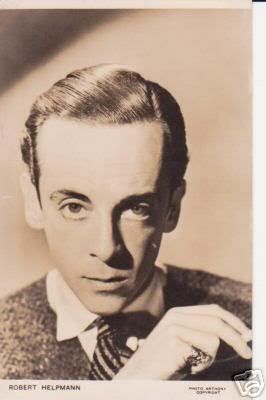
"Bobby dazzler!" Robert Helpmann

Robert Helpmann haunted my childhood. Forget Darth Vader, the Child Catcher in Chitty Chitty Bang Bang was much more frightening. Darth Vader frightened me in a dark cinema, the Child Catcher in a well-lit family room and followed into my dreams at night.

Helpmann is a major figure in the history of English and Australian ballet, as well as an actor, playing lead roles with the Old Vic and touring Australia and the United States, directed ballet, plays and opera, as well as choreographer and creator of ballets. Indeed, I see the Australian Ballet is doing The Merry Widow, which was created by Helpmann and was a major critical and popular success around the world. He appeared in Olivier’s Henry V and Powell and Pressburger’s The Red Shoes (for which he also choreographed the ballet in the film.) He was created a knight and a major Australian performance award is named after him.

And yet I wonder if he isn’t a somewhat forgotten figure. Maybe I’m projecting my own ignorance onto the wider public (and my ignorance of ballet is almost profound in its totality) but I think Nellie Melba or certainly Joan Sutherland would have greater name recognition. Graham Murphy, who started as a choreographer under Helpmann, would possibly be our most recognised male ballet dancer and choreographer. And yet in terms of the depth and width of impact over a wide range of artistic endeavours, Helpmann leaves them all in the shade. No shame on them, but shame on us if Helpmann is not the well-remembered artist he should be.

This was all prompted by Anna Bemrose’s 2008 book Robert Helpmann: A servant of art. I’m afraid I’m going to have to call this a worthy book. The writing is dry and uninvolving. Though it covers Helpmann’s career and major works in good detail, Helpmann’s personality comes through only fitfully in glimpses. There is little or no mention of his private life which is fine but I don’t feel I know Helpmann, or indeed his inspirations and drive, any better for having read this book, and I wish I did. Perhaps a book of other people’s recollections of Helpmann might serve better in this respect, such as George Plimpton’s book on Truman Capote. It is only in the quotations from people such as Maina Geilgud and Margot Fonteyn that we see the man. Which was a little disappointing.

However, it is a sobering thought to realise on reading books such as this and John Bell’s autobiography just how young the professional performing arts companies in Australia are. I have had the privilege and pleasure of working with people who were part of the creation of the Queensland Theatre Company as well as other companies. Opera Australia was only created in the 1950s, Australian Ballet 1960s, the acting companies in the 70s. If we still have the challenge of finding audience and justifying ourselves to governments, funding bodies and the general audience, surely part of the reason is the profession’s relative youth.  If we are not part of the lifeblood of Australia in the same way sport is, we’ve been doing sport a lot longer. Maybe we will never make that grade, and will always be a niche market. Certainly theatre in all its forms is struggling all over the world. Stephen Sondheim in his book Finishing the Hat says he now wonders, as he once never did, if there will always be a place for live theatre. Australia has come to the game late, and maybe we are fighting the darkness, but sunsets can dazzle. For some people, it’s the best part of the day.