Showing posts with label Cold War. Show all posts

Monday, June 17, 2013

'Warriors three' - The Collapse of the Soviet Union


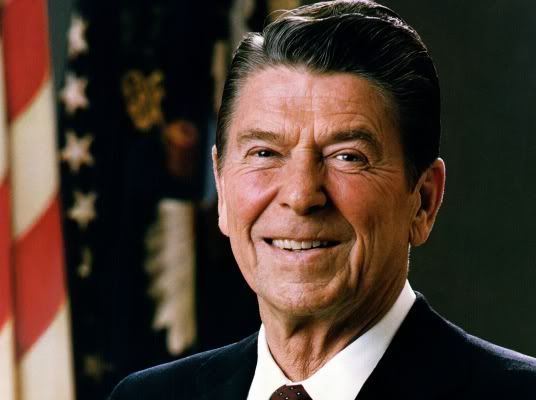
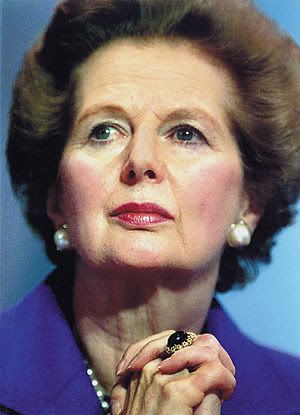
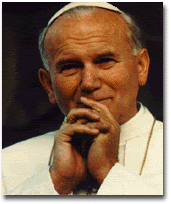
Margaret Thatcher, Ronald Reagan, John Paul II: there are no finer names to get Lefty blood boiling. John O’Sullivan, a conservative writer, journalist, and editor and one-time advisor to Thatcher, finds all three admirable. But then that’s how it goes. One side’s heroes are another side’s villains and God forbid we should find anything admirable in our villains or disappointing in our heroes. Not that The President, The Pope and the Prime Minister: Three who changed the world is a hagiography. But it is certainly written from a conservative viewpoint.

Its main thrust is the part these three played in the collapse of the Soviet Union. There are those that will tell you the Soviet Union would have collapsed anyway. Oddly these are often the same people who were screaming at the policies that were brought in place to try and engender the collapse of the Soviet Union. These policies will never work! They’re dangerous! We’ll be at war before the USSR collapses! [USSR collapses] Oh well, that was always going to happen.

This is the argument used whenever someone we don’t like does something that is good; that was always going to happen, or as an alternative, oh anyone would have done the same in the same circumstances. God knows I’ve done it myself. But John O’Sullivan shows that the downfall of the Soviet Union was brought about in large part due to the change in direction at the Vatican, Downing Street and the White House when these ‘conservative’ leaders took quite radical turns.

It was Richard Nixon who engineered Détente, a policy of co-existence that was to ensure that the two
most powerful nations in the world would have no reason to go to war. But what this did, as writers and dissidents such as Natan Sharansky will tell you, was to trade the human rights of people living under the Soviet Union for international stability. Living in a Western democracy that now was under less threat, this probably seemed like a good deal. Living in a gulag, less so.

Reagan, Thatcher and John Paul II refused to accept the Soviet Union as a fact of life. And this was quite a radical step. During Reagan’s presidency for example, Teddy Kennedy visited the USSR to advise them how to deal with Reagan. This was not done out of any traitorous leanings but because Kennedy, like so many, assumed the USSR was not going anywhere and so to antagonise them as Reagan was doing, was dangerous. It was sincerely held belief, and as it turns out, wrong.

John Paul knew what living under a Communist dictatorship was like, which drove his policy towards the Soviet Union. His visit to Poland in 1979, which O'Sullivan sees as a starting point, was greeted by thousands and thousands of his fellow Poles, giving them the knowledge that their unhappiness with their government was shared by millions of their fellow Poles. Between his speeches calling for free and just government and their sheer will and numbers, the Poles received strong moral support for their long and difficult campaign for freedom.

This was supported by political, military, economic and moral pressure from Britian and the US. Sullivan brings together many of the events of that time from 1978 through to showing the effect on the Cold War endgame, including the Falklands War, the Iran-Contra scandal, and the assasination attempts on all three of his main players. Some of the stories as played out in popular culture are revealed as having layers. For example, Reagan’s Star Wars Initiative as it was known was a controversial attempt to build defensive missile shield in outer space. This was portrayed at the time as as dangerous game of military-economic brinkmanship. Less well known was Regan’s repeated offers to the USSR to share the technology. If both sides had it, then they could both reduce their nuclear stockpile as it would not be much use. This offer was knocked back, more than once. Certainly I never knew this. Doubtless the element of risk was still there. But if O’Sullivan’s account is accurate, Reagan read the Soviets better than they read him.

 Of course it was not just these three people who brought about the change. From Lech Walena through to the thousands of politicians, workers, protesters and dissidents in many countries, most of whose names we will never know, there were many others, and their struggles and sacrifices were crucial. But their efforts would have been in vain without the support of these leaders showing it in practical terms on the world stage.
You can read of more critical accounts of this time - His Holiness by Carl Bernstein and Marco Politi, for example - if you wish, and I don’t claim this book to be the final word. Any big topic like this requires wide reading. Nor, before anyone jumps and down, do I claim these three are beyond criticism. But it shook a few of my preconceptions of the time, particularly my view of Reagan, and that’s a good thing. If you only read to find writers you agree with, what’s the point of reading at all?

Tuesday, July 19, 2011

"All my games are real." Chess and politics

War, said Claus von Clausewitz, is politics by other means. The Cold War was war by other means. The USA and the USSR tried to defeat each other by any means short of actively fighting a war against each other. The means ranged from machinations in the UN to wars by proxy to assassinations through to, perhaps oddest of all, chess.

Daniel Johnson is an English journalist and chess amateur. His 2007 book, White King and Red Queen: How the Cold War was fought on the chessboard, traces the history of chess as it was used as a tool of politics. For the Soviets, this was a deliberate step. The intellectual nature of the game attracted them to the idea of using it as a way of demonstrating Soviet superiority over the west. (Star Trek uses three-dimensional chess to show Vulcan superiority over human intellect. But I digress.) They threw millions at it, both of money and of hours. Like everything else, it was entirely government controlled from the Grandmasters' championships to local clubs.

And for a long time it worked. The USSR dominated world chess throughout the Cold War. To do this, they relied heavily on non- Russians and Jews, which in the racist, insular, anti-Semitic system that was the USSR rankled with many. But they could overlook that as long as the USSR produced the world champion. And with the exception of Bobby Fischer (himself a Jew, albeit an anti-Semitic one) they did. They rigged competitions, and dominated and bullied the World Chess organisation FIDE to get their way. They lost their dominance for the same reason they lost the Cold War, a ruined economy, a country that was moribund in terms of technology and an oppressed people who finally had enough. Their last champion, and one of the strongest players in history, Gary Kasparov, became a dissident and is currently one of the opposition leaders against the increasingly despotic Putin regime, facing imprisonment or worse. The present world champion is Indian Viswanathan Anand.

Johnson puts this extraordinary campaign in the context of both the history of chess and of the world, with the main focus on 1945-1993. I have little idea of chess beyond the idea of how the pieces move, but I found it fascinating, and easy to follow, even for the chess patzer such as I. It’s a dramatic story with extraordinary characters. Bobby Fischer is not the only madman in the book. Johnson makes a good argument that for Fischer and others like him, it was not chess that made them insane. It was chess that kept them from going insane, and when they abandoned playing, their powerful minds turned on themselves. And certainly the paranoia and neuroses of Fischer was shared by many of the Grandmasters, increasing as the championships become more and more seen as the clash of civilisations.

Like a good non-fiction book should, it made me want to learn more about the subject.  And I’m now thinking of trying to learn to play chess properly. And it leads to the broader subject as well. Natan Sharansky was a great player who never become world champion. He did become a cause celebre in the USSR, enduring imprisonment, exile and a decade long separation from his wife because of his religious and political views. After finally being allowed to emigrate to Israel, he pursued a poltical career. He has now written two books (as well as his autobiography) that I feel I must read. One book, The Case for Democracy argues that Western democracy has core values that are strong enough to overcome radical Islam. Another book, Defending Identity, makes the case that strong identity, whether it be religious or nationalistic, can be forces for good and are essential against totalitarian movements. Given the history of the Jews in general, and the Jews and the small countries in the USSR, one begins to see his point.

Emmerson said in every work of genius we recognise our own rejected thoughts. In good writing, we can also recognise the thoughts we have, but have not been quite able to articulate. I have been thinking that in our attempt to be tolerant, pluralistic, non-judgemental, all good qualities, we present a picture to the world that we stand for nothing and care about nothing. And it is this vacuum that fundamentalism and other fanaticisms rush to fill. The other way is to drift into a nihilistic world of the next sensation, the next way to avoid boredom and ennui.

Or to try and put it another way, a functioning society tells a story of where it has come from and where it is going. And members of the society should be in broad agreement with that story. In a healthy society, we will argue, discuss, and try to shift that story one way or the other, but the broad outline must exist. I don’t think we have a story anymore. We must rediscover it.

Wow, how did I get here? From 32 lumps of wood on 64 squares to the future of Western Civilisation as we know it. In a pale safe shadow of the journey of Sharansky and Kasparov I seem to have found a move from chess to politics.