Showing posts with label 20th Century. Show all posts

Monday, March 19, 2018

Old movies, forgotten awards

I don’t think I particularly like the Oscars anymore. I was never mad for them, didn’t sit up watching till midnight avoiding the news so I wouldn’t know who won what, or of later years trying to find a venue to watch them live. Awards themselves are of dubious value, award shows even more so. When Nicole Kidman pretentiously said “Art is important” to defend her going to the Oscars in the wake of 9/11, the obvious riposte, “Yes but award shows aren’t”, wasn’t mentioned. Ultimately, good work doesn’t always get awards, and awards don’t always go to good work. And as Johnny Carson (I think) said, the Oscars are two hours of entertainment jam-packed into a five-hour show.

Over the last few years Hollywood’s night of artistic self-congratulation has turned into a  night of moral self-congratulation, when stars wear dresses of a certain colour or badges to show their disapproval of an appalling mode of human behaviour that has been in the headlines mainly because it is prevalent in Hollywood, whose disapproval is strongest in hindsight. They seem to confuse wearing a designer dress of one colour instead of another as some form of activism, like those people who wear “This is what a feminist looks like” t-shirt regardless of how they actually treat women in real life, or those people who wear Che Guevara t-shirts and have never once gone from war to war so they can shoot people (I assume that’s what they’re supporting; it was Che’s favourite activity.)  I’m not sure how many more open secrets Hollywood can all pretend to be appalled by.

I also dislike the articles that appear discussing the films etc that should never have won the Oscar. I think they’re mean-spirited (which admittedly is spiritus temporum) and again confuses awards with the worth of a film. I of course have my opinions on films I think weren’t worthy winners but good luck to those artists. It doesn’t change anything that matters. So overall, while I will never claim to be uninterested in the Oscars, I am tending towards the disinterested. 

But I still like films. One good thing this year is the Foxtel are showing all the best-film award winners in order. I say ‘all’, it’s actually ‘a lot’ but does include the first, 1927’s Wings, through to last year’s Moonlight. There’s a lot there I’ve only ever heard about but never seen: All about Eve, The Apartment, The Deer Hunter, and those that I haven’t seen for a long time: Shakespeare in love, which I will defend to the death so sod off. I would love to have the time and wherewithal to sit and watch for several days, which is a ludicrous idea but still. It’s sobering to consider how many of these films are forgotten. But such is art - and awards. 

One film I did watch was 1930’s big winner All Quiet on the Western Front, which won Best Picture and Best Director. It’s one year older than my Dad, and like him, sometimes shaky but stands the test of time well. The acting can be wooden and melodramatic but the film itself greatly affecting. A class of young German schoolboys are implored by their fiercely-patriotic teacher to enlist in the early days of the war, and we follow them through training, battle and their deaths. (Spoiler-alert I guess - but the film is 88 years old and the novel older and WWI isn’t a byword for happily-ever-after.) Some die on the battlefield, some in the hospital. One soldier spends a night in a shell crater, watching the enemy soldier he stabbed die over the course of the hours. He goes home but find no-one understands what he’s been through, least of all the teacher who started him there. It’s following them on this journey that makes it such a moving film. The ending is devastating and the final shot haunting.


The novel was written by Erich Maria Remarque, a WWI veteran, based on his experiences in the German army. Making the film in the late 1920s meant there were plenty of veterans around to act as advisors, in particular Germans, some of whom appear as trainers in the training sequences. The battle sounds are like nothing I’ve ever heard. An old corporal, Kat, describes the sounds of different shells to the newcomers, and I think this specificity is reflected in the soundscape. This closeness to the original event I suspect gives the film a verisimilitude later films can lack, despite advances in technique.

It’s also interesting to watch a film made before Hollywood imposed the Hayes Code on itself to prevent government censorship. A French soldier is blown up leaving nothing but his hands still clinging to the wire - a memory of one of the German veterans who worked on the film. Swimming in a river behind the lines, the young German men spot some French women and bribe them with food. Bare bottoms are seen when they boys show off in the river, and it’s clear the night does involve sex, without being explicit. This sequence is at once touching and pathetic. The women are desperate for food, but the subsequent liaison is one of genuine human connection, which both parties are clearly craving. It’s a
sequence that would not have appeared a decade later for example. For different reasons it may not appear if the film were made now. (There are stories of a new version coming.) And I don’t know if it’s a reflection of German society of the novel or American society when the film was shot, but the boys are also much freer displaying physical affection towards each other. It makes them seem much younger, and their descent into the horrors of war that much more terrible.


The film, like the book, was banned in Nazi Germany for the negative picture of the war. The film was banned in Poland and France for being pro-German. Controversial in its day, still affecting now. We should all be so lucky in the work we create.

Tuesday, March 13, 2018

The Uses of Churchills

Just recently we’ve had a lot of Churchills. Gary Oldman won an Oscar for his, John Lithgow won high praise for his, and Brian Cox … well, Brian Cox got stuck with an incredibly dud script. We’ve also discovered that if you make a show with Churchill, you get to add a great part for a  female actor of a certain age: in these three examples, Kristin Scott Thomas, Harriet Walter and Miranda Richardson, all play his wife Clementine who was his great supporter, sounding board, conscience and moderator.

But there’s been great and lesser Churchills before 2017. In 2010 Churchill inexplicably turned up as George VI’s supporter in The King’s Speech, played by Timothy Spall. Albert Finney played the part with Vanessa Redgrave as Clementine in 2002’s The Gathering Storm, Brendan Gleeson and Janet McTeer in the 2009 sequel, Into the Storm. Last century saw Robert Hardy in The Wilderness Years with Siân Phillips, an eight-part television series (playing Churchill was a theme of Hardy’s career) and Simon Lord as Young Winston with Pippa Steel as young Clementine. And that’s just the highlights.

There’s little mystery as to why Churchill attracts writers and actors. He was born in the age of Victoria and died in the Second Elizabethan Age, a name he coined, living through almost a century. He was a lonely neglected child. He took part in the Boer War and both World Wars, as reporter, soldier and politician - in WWI, soldier and politician. He went from outsider, to insider, from party to party, from voice in the wilderness to the roar of the British Lion. He was given the job of Prime Minister at perhaps the most vulnerable point of Britain’s long history and lead it to triumph. He was a prolific historian winning the Nobel Prize for Literature, and also Time Magazine’s Man of the Half Century. Often wrong-headed, he was responsible for military disasters such as Gallipoli and Norway, and yet without him, who knows how long the Nazi control of western Europe could have lasted, and with what consequences. He fought for the Empire and lost it. And at the height of his triumph in the Second World War, he was dumped by the British public who never quite forgave the Tories for the 30s. It’s a hell of a story. Combine with that his character and physical characteristics - the voice, the oratory, the cigars, the drinking, V for Victory, the wit - it’s almost as he decided to gift future actors with too much to work with.
Which makes one wonder, why make stuff up? History doesn’t happen in neat dramatic lines of course and so a certain amount of trimming and editing is part of any historical script. Both The Crown and Darkest Hour have also altered history but not I think fatally. Darkest Hour has Churchill hopping on to the underground. As history it’s wrong and out of character, but dramatically it works. It also talks to Churchill’s ability to draw inspiration from the people, and his actual habit, later, of getting the results of some of the first political polling in Britain. It dramatises the strong connection between Churchill and the people during the war.

The Crown goes a little further. When Churchill had his stroke in 1953, the Queen was one of the first people informed, even if it was kept secret on a wider scale. Churchill was a lot of things but never deceitful to the Crown. Not so in the show. But the show is about Elizabeth II and it gives Claire Foy a wonderfully-written scene where she scolds Churchill for his deception, putting him in his place, while demonstrating her respect for him. It’s beautifully played too by Foy and Lithgow. My favourite episode of The Crown was later when Churchill was having his portrait painted by Graham Sutherland. Again it’s beautifully written and played, this time between Lithgow and Stephen Dillane as the artist. I can forgive a lot for that.

But Churchill. Oh my dear, Churchill.

Winston Churchill as a panicky fool so overwhelmed by his doubts about D-Day that he prays in cod-Shakespeare for a storm to wreck the invasion. Churchill despised by his generals. The screenwriter, Alex von Tunzelmann has taken some facts, such as Churchill’s suggestions for diversionary attacks on other fronts, and the sidelining of the UK as a world power, and spun pure tosh. Ironically Tunzelmann is an historian who wrote a series of columns about historical films, rating them both as films and as history. Her own work fails as both - it’s a dull silly film and execrable history. I have not read any of her other work but this seems to be her first crack at World War Two, and at film writing. I hope she  improves in both. Her thesis is bad and her exposition clumsy. “This is our last briefing on Operation Overlord, the assault on the German occupying forces in the north of France,” announces John Slattery as Eisenhower. One almost expects one of the other generals to pipe up “We’re going to do what to who now?”
Many writers proclaim their discovery Churchill’s feet of clay as if they’re the first ones. And we live in an age that loves to drag down great people to our level - or lower if possible. I can’t think of any other reason you would write and produce a film so poor as this. Which is a pity; there’s a strong cast of British and American actors wasted here. There is, as a friend of mine much more knowledgable about these things said, a good film to be made about British doubts about Operation Overlord. There is also plenty of material to play with about the relationship between the British and American generals before and after D-Day. This film is not that film.

Ah well, you say, it’s just a film. But history is taught less and less at schools and most people’s understanding of history is drawn from films and television. I think it’s becoming more important for screenwriters to get history right. With any luck, Churchill will gain the fate it deserves - forgotten and unlamented.


Monday, May 15, 2017

Staring into the abyss: Looking back on some recent history

I once read a article criticising George Lucas. I know, I’m as shocked at you are. The author took exception to Yoda’s lines, “Fear is the path to the dark side. Fear leads to hate. Hate leads to anger. Anger leads to suffering.” He summed up his objection to this by saying no-one ever hated Hitler so much they became a Nazi. (Never mind that Yoda never makes the link from fear to the Dark Side complete. Suffering leads to the Dark Side? Or what? Damn you Yoda, I need closure.)

Whoever the writer is, he may now have to concede Yoda was on to something. I did study 20th century German history, including the rise of Hitler to power, as part of my Arts degree. That was some time ago, but when people kept insisting Trump was exactly the same as Hitler, I kept wondering if they knew something I didn’t. To be frank, I was fairly sure they were wrong and engaging in hyperbole (once again, shocked as you are) but I thought I’d better check again, just to be sure.

So I listened to Richard J Evan’s The Coming of the Third Reich: How the Nazis Destroyed Democracy and Seized Power in Germany via Audible This is the first volume of his Third Reich Trilogy which has been acclaimed as the best general history of the Third Reich extant. To sum up, I was right. The differences between Hitler’s climb to power via multiple election campaigns  and Trump becoming President almost on a whim, and the vastly different histories of Germany and the United States, are too many to go into here. Read the book. One major difference is that Hitler was able to destroy the Weimar Republic in large part because many of the other parties, Right and Left wing, were committed to doing the same thing, and previous administrations had already greatly reduced the role and power of the parliament long before Hitler put it out of its misery. But I digress.

What did strike me as having similarities to today’s politics were some of the Nazi tactics. The SA brownshirts were well-known for beating up opponents in the streets or at their meetings. (As were the Communists.) And if the Nazis weren’t able to prevent speeches other public events  being run by political opponents on the grounds of public safety (mainly fear of the fights that would break out orchestrated by the Nazis) they would attend the event and with shouting and other methods make it impossible for the event to continue.

Let’s see: beating up opponents, preventing speeches on grounds of public safety, and shouting down speakers. Who does this these days?

Mainly it seems to be people who don’t like Trump. The so-called Antifa (Anti-Fascist) movement actually appear in masks and beat up Trump supporters. At least the Brownshirts showed their faces. Students who consider themselves liberals ie those who respect other people’s opinions and beliefs even if they differ to their own, shout and disrupt and in some cases physically threaten speakers they don't like to stop them speaking on their campus. They have built barriers and lit fires to stop people from going in to listen. And that’s if the university administration haven’t already withdrawn the invitation to speak on grounds of public safety. 

So Yoda has been in some way vindicated, and George Lucas revealed as a writer of surprising prescience. There are people who hate Trump so much they have become fascist in order to stop him. To quote Christopher Booker, "Evil men don't get up in the morning saying, 'I'm going to do evil.' They say 'I'm going to make the world a better place.'" Or to quote Terrence Rattigan, "The trouble with being on the side of right, as one sees it, is that one often finds oneself with such questionable allies."

Tuesday, May 9, 2017

The old sow that eats her young: surviving Ireland

The history of twentieth century Ireland is a complex one, with wars, terrorism, partition, combined with strong social conservatism, religious oppression and economic depression, yet coupled with a strong and vibrant culture and economic revivals, all culminating in a peace process that is still playing out.

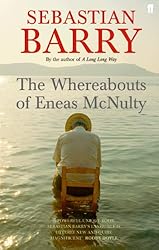
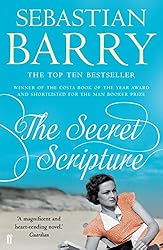
Sebastian Barry is fascinated with this history, particularly the turnaround from 1916-1921, when via wars, terrorism and negotiation, a British Colony became a divided country and loyalties were overturned and vilified. Barry’s McNulty brothers of Sligo, Eneas, Jack and Tom, all live through these times and later decades. How they do so, the effects on their lives and the lives of those around them, form the core of three of Barry’s novels, The Whereabouts of Eneas McNulty (1998), The Secret Scripture (2008), and The Temporary Gentleman (2014).

The three novels do not operate as a trilogy in the traditional sense of telling one story in chronological order. Rather we get stories that by their nature overlap, sometimes illuminating each other. It’s more a mesh than a thread. I read them in reverse order of publishing. In reading The Temporary Gentleman, there was a reference to his sister-in-law being confined to an isolated hut and I thought, what’s that story? I was delighted to discover there was a novel that told it: The Secret Scripture. Having read that, I wanted to learn more about the oldest brother Eneas who could only visit his family furtively. So they can be read in any order. And they encourage rereading of each other. We know people remember the same events differently and Barry has captured that very well. 

The narrative style of each book is different.  Eneas’s story is told in third-person. The Temporary Gentlemen is told as a journal, middle brother Jack trying to work out the steps whereby he ends up a remnant of the British Empire living in Africa’s Gold Coast. The Secret Scripture is two journals, one from Tom’s wife, Rosemary, now around a century old and living in an asylum, and that of her doctor, William Grene. 

Both Eneas and Tom suffer from having taken ‘the king’s shilling’. A stint in the British Merchant Marine during the WWI sees Eneas ostracised on his return home. With little other option, he takes a job in the Royal Irish Constabulary and that puts him on an IRA death list. It is his best friend from childhood who is designated to warn him off. For the rest of his life, Eneas is on the run, a wanderer like his namesake. 

Glamorous Jack ends up in the British Navy in WWII, but his main problem is his drinking, which affects not only him and his career but has a devastating affect on his wife Mai and their children. Only in exile, writing his journal, does he start to realise that he may be the bad guy, the person responsible for all that has gone wrong in his life - and his beloved wife's.

Tom also marries a beautiful woman (Barry thinks being beautiful in Ireland is a forerunner of tragedy). Haunted by memories of her childhood, her father, rebels and soldiers of the civil war, Rosemary breaks the social mores of Sligo and ends up rejected by her husband and condemned by the local priest. She is imprisoned first in a lonely shack then the asylum. As she tries to remember events from nearly a century ago, her doctor is trying to do the same, finding old records and piecing together her story. With mental illness in her family, plus decades of confinement, Rosemary is not a reliable narrator, but then, neither is her doctor or priest.

Barry has taken fragments of his family’s history, and turned them into gripping narratives. I would be interested to know how much detail of the other stories Barry had worked out when he wrote the first in 1998, as they work together well. His writing is poetic and lyrical. The endings of all three tend towards the sudden, and I’m not convinced they entirely work, but these are still three excellent novels.

And the mesh is widening. In New Orleans, Eneas wonders if he should stay in the States, perhaps find his great uncle who emigrated there. That uncle's story has now been told in Days without End (2016), a novel set in the US Civil War. Like The Secret Scripture, it has been awarded the Costa Book of the Year. Another visit to the McNulty family beckons.


Thursday, May 4, 2017

"Will I look back and say that I wish I hadn't done what I did?": Lives of the Beach Boys

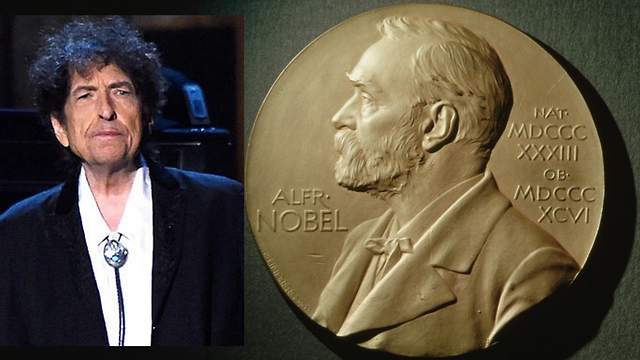
Did you hear? Bob Dylan won the Nobel Prize for Literature, for his lyrics, a decision I’m still not convinced by. I’m not sure how comfortable Bob is with it either, given his reluctance to go and collect the thing. I know a trip to Sweden with a dinner, gold medal and a lot of money sounds horrid but it can’t be that bad.

But I suspect part of his reluctance is part of my discomfort; lyrics aren’t poetry, and don’t operate on their own. They aren’t written to be read or recited but rather sung or listened to. Which isn’t to say a good lyricist isn’t as skilful or artistic wordsmith as any other writer. But for a lyricist words and music, as the old Jo Jo Zep song said, go together. There have been a number of books about music or lyricists that have the words printed but the only way you can really read them is to have the tune in your head as you do so. Otherwise they lose a lot of their life. And while there is no Nobel Prize for music, there’s none for mathematics, art, architecture, engineering, and a whole lot of other human endeavours as well, and it doesn't make them less important.

The interplay between lyric and melody is crucial.  Tim Rice in his autobiography quotes the first verse of his lyric for the tune that became “I don’t know how to love him,” which he maintains would have killed that song dead had it ever been released, despite the melody.  All together now: 

I love the Kansas morning
Kansas dawn comes to greet me
Kansas winds
Shift and sigh
I can see you now, we’re flying high
Kansas love of mine

(It’s a prison song, a man in a jail cell in Maine lamenting his girl back home. Really.) On a more worrying note, George Gershwin’s songs are sung less and less, due largely to his brother Ira’s sometimes twee lyrics, despite the beauty of the melodies. Words and music go together.

Which brings me in a very roundabout way to two autobiographies I have read lately from two of the founding Beach Boys, Mike Love and Brian Wilson, both released in 2016 within weeks of each other. Mike Love is the front man of the band, one of their lyricists, and still goes about with a band called ‘The Beach Boys’, although he is only original one there.
Brian Wilson who wrote, arranged and produced the Beach Boys music, also tours but with ‘The Brian Wilson Band’ as Love has the legal rights to the name. It’s a long story.

The two books couldn’t display a greater contrast. Love’s is chronological, detailed, sometimes to the point of tedium, and I have to say, aimed at scoring and settling points. He feels his part of the Beach Boys’ success has been undervalued both financially and artistically. And to be fair to the man, he’s right. His lyrics on surf and girls was one of the features of their early albums and a big part of their appeal to people who had never seen the beach, leading to their worldwide success. As lead vocalist and front man, he was a dynamic performer. His name was kept off many of the singles for which he was lyricist (by Murray Wilson) and he had to sue to get his rightful recognition and money. Despite his practice and championing of transcendental meditation, he clearly has trouble letting go of years of resentment and anger and it seeps throughout the book.

Wilson’s books is more amorphous, drifting from present to past, in no particular order.  He can go from a description of his current family life to a session of Pet Sounds almost in a sentence. The oldest son of an abusive father, he has famously struggled with mental health and substance abuse issues, and these things affect him still. He finds it difficult to talk about his father Murray, the man who gave him music, who was crucial to the band's early years, but who also beat him and belittled him. His therapist Gene Landy saved his life, but also drugged him, abused him and exploited him. Yet here Wilson is, still writing, still performing but also aware of what his survival has cost. The book can be generalised at times, but at others picks up details and stories that may otherwise have been overlooked. He’s not the most reliable narrator, which he is aware of, but the writing is never confusing, and throughout displays a generosity of spirit that is lacking in Love’s work. 

Love is defensive. Although he is open about his own shortcomings as husband and as a father, as a band member he did no wrong. All those stories you heard about his criticisms of Pet Sounds or SMiLE? “Don’t fuck with the formula”? Never happened. Not one of them. Ever. And so much of the Beach Boys music would never have happened without his magic touch. Just a word, a minor suggestion and near disaster turns into commercial magic. I think he is overplaying his hand. He is also trapped in that idea that good work is commercial work, otherwise it's not good. He's not alone there.

Love’s greatest problem is that he is a classic Alpha male in a situation where he must play second fiddle. While his lyrics work in the main part, that is all they do. They don’t get taken out of the song and quoted, they way Dylan’s do. Or The Beatles. He is a workaday lyricist, successful for sure but no more. Nor as he got older did he ever really attempt to move on from his milieu of beaches and girls. Sometimes it worked - “Do it again”, “Kokomo” - other times it was embarrassing, tending towards creepy - “Hey little tomboy”. Love’s attempt at being political , “Student Demonstration Time”, is likewise painful to listen to, and his song about transcendental mediation oddly jarring. I have read some of his solo work is quite good but I haven’t listened to it.

The greater talent in the band was of course Brian Wilson. His melodies, his harmonies, and his arrangements are some of the greatest in the pop era. What still draws people to the Beach Boys is this music, sometimes in spite of the lyrics. “Don’t Worry Baby” is a stunningly beautiful song - about drag racing. They lyrics here are by Roger Christian, who wrote all the car song lyrics. Other lyricists include Tony Asher (Pet Sounds), Van dyke Parks (SMiLE), himself and other band members. Another big hit "Sloop John B" was a cover of a folk song. As he got older, he pushed himself as a musician, which lead to seeking out new collaborators. Some of his most beautiful work was not commercial but was genuine artistic expression.

In short, Brian Wilson’s successes were not limited to his work with Mike Love. But Mike Love’s success is limited to his work with Brian Wilson, and he resents it.  (Another exception here: "Kokomo" was the Beach Boys’ only number one hit for which Brian Wilson neither wrote or produced.) But at their height of commercial success, Wilson and Love were the core of the Beach Boy's writing. The biggest hit for the band, "Good Vibrations", was a Love lyric to Wilson's music and arrangement. Mike Love has been undervalued for his contribution to the band, and unfairly characterised as the Villain to Wilson' Hero. That said, I think the main difference between these two autobiographies is instructive:  Love admits to Wilson’s talents, while Wilson champions Love’s.

Wednesday, January 18, 2017

Let the Trumpfish sound? The history of Huey P Long

It starts with a Democratic Party running a primary where 'the powerful politicos decided the results beforehand and controlled the voting by means both fair and foul", and whose candidate "ignored the rural and impoverished areas." It went into a campaign described "as amusing as it was depressing", and ended up elevating into public office "a man possessing neither culture nor refinement, a man whose every public or private act is offensive to good taste", a man "without a scintilla of respect for worthy womanhood."*

Louisiana state politics from 1928 to 1936 is not exactly a world away.

The man then was Huey P Long, Governor, Senator and Presidential candidate. He called himself the Kingfish, and the nickname stuck. For his admirers, and they ran into the tens of thousands in his home state and through the country, it spoke to his down to earth manner, his humour, his preparedness to get down and dirty if he needed to, and his slogan, Every man a king. To his enemies, who numbered about the same, it suggested a bottom feeder in a swamp, dangerous and difficult to catch.

He took Louisiana out of the dark ages in many ways. He built thousands of miles of roads, bridges over the Mississippi, gave free textbooks to all school children, expanded and improved the state university, and instituted literacy classes for adults. He did so through coercion, a wide system of patronage, extortion, bullying, kidnapping, nepotism (which didn't always work - his brother was one of his greatest opponents), almost bankrupting the state and making himself very rich indeed. He took control of the powerful Democratic Party machine, that tried and tried again to stop him for their preferred candidates, and made it his own. When he died he held operating power in almost every government institution the state of Louisiana had to offer. He was the nearest thing the United States so far has had to a fascist leader.

Huey P Long inspired art, Sinclair Lewis's "It can't happen here," the story of a home-grown American fascist leader, and Robert Penn Warren's "All the king's men" the story of a backwoods politician who turns from idealist to demagogue. Both novels have been turned into plays and Warren's twice into a film, once in 1949 to Academy-Award-winning effect, and again in 2006 to lesser effect. (Some acting is so bad, someone once said, only a great actor is capable of it; hello Sean Penn.) The art, it must be said, had no effect on him. (To be fair, he was mostly dead at the time.)

I first came across the Kingfish when I saw the second half of a Ken Burns documentary. At the time he reminded me of Queensland Premier Joh Bjelke-Petersen who likewise took an economically backward state into the twentieth century by fair means and foul. But the Kingfish was Joh only more so. Both used the elite branches of the police service for political purposes, but Joh never set them on political opponents, brandishing their machine guns, forcing them out of buildings. Nor did Joh ever get into fistfights on the floor of parliament. Or kidnap anyone.

Long came to mind more recently for obvious reasons. People want to compare Trump to Hitler, largely because Hitler is one of the few people from history who is generally known. If you don't like someone's politics, there's no-one else to compare him to. It's easy, and generally unhelpful. But he reminded me of Long - the vitriolic attacks on opponents, the disdain for the press, the hatred by his enemies, the worship by his admirers, playing to the crowds, and the strong appeal to people who felt forgotten by a complacent government. And the abuse by his opponents of his followers. In Burns's documentary there is footage of a politician dismissing Long's appeal as merely to "the ignorant in distress", as if dismissing them with the former epithet meant you could ignore the latter. And in the end, Long was assassinated. People are already hoping the same will happen with Trump. Too often people opposed to violence and hate find both quite acceptable if aimed at someone they don't like. 

Long also built an enormous tower to his own memory. It's the Louisiana State Capitol and you can see it for miles as you drive towards Baton Rouge. It's ludicrous, 36 stories high, looking as though it's a New York skyscraper that got lost, 48 steps leading to the front door, each engraved with the name of a state in order of admittance to the union (Alaska and Hawaii since added to the top step), and marble sourced from around the world in the foyer. It cost $5 million dollars in Depression dollars. God knows what it would cost today. Facing it across the lawn is Long's grave, topped with a large monument, featuring a statue of Long staring at his Capitol. The guides like to tell you that the concrete monument was paid for by his opponents, to make sure he couldn't get out. (Worth doing the tour if you're in the area) So vanity - there's another common feature to the two men. (Also, as self-given nicknames go, 'The Kingfish' is much better than 'The Donald'. What does that even mean?)

But there are big differences between the two, and they're in Long's favour. Long was a dynamic speaker, both with prepared speeches and off the cuff. An opponent tried to appeal to the poor by talking about his childhood in bare feet. Long responded "I can go one better than that! I was born in bare feet!" Long was also extremely intelligent. He studied law for one year (of a three year course), missed most of his classes and failed his subjects. He insisted on sitting the bar exam however, and due to his own hard work and private study, passed. He later argued in the Supreme Court, where noted jurist Oliver Wendell Holmes praised his legal mind. (He often appointed himself state counsel while Governor, another way to line his own pocket.) This was also a product of his prodigious memory, which meant he remembered clients from his days as a salesman when campaigning, nor never let a slight go or an enemy unpunished. (Pettiness - that's something else they do have in common.) He worked fantastically hard travelling thousands of miles (even before he had improved the roads) into the poor and rural areas of the state and made them his own. James Thurber, the novelist, cartoonist and humorist, remembered his almost constant state of movement, even when 'relaxing' in his hotel room.

But the biggest difference is that Long knew how to run a party machine, government departments, and both houses of a legislature. Yes he did so corruptly, but as more than one enquiry found, that was business as usual in Louisiana, taken to the nth degree. Trump has no experience in this area at all. Even the General presidents, Grant and Eisenhower, who had never held public office, knew how to deal with massive organisations under astonishingly adverse conditions, while dealing with the quirks, varying skill levels and interpersonal squabbles of subordinates. I'm not sure what Trump brings to the table, except enormous self-belief. His own party don't like him and he has no legislative experience. He keeps talking of his business nous, but this seems spotty at best. Imagine a general arguing "I won a number of battles to be fair. Not the war, sure, and some of the other battles were pretty grim if I'm honest, but you know, some." So whatever he may want to do or not to do,  you have to query his ability to do so.

Huey P Long for all his considerable faults was fighting for the poor of his state, and did improve infrastructure and education. He lost sight of his ideals, and confused the means, acquiring all the power he could, for the end.   What is Donald Trump fighting for?  Most of the leading political analysts knew he could never win the election, so they can't tell us. We're getting four years to find out together.


Wednesday, December 17, 2014

Sic semper: Killing Kennedy and Lincoln

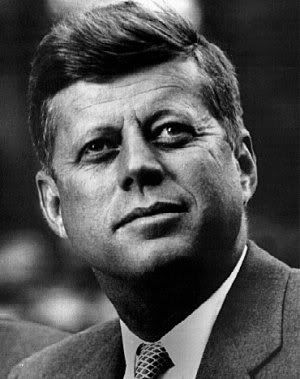
Lincoln and Kennedy are the bookends of presidential assassinations. There were attempts before and attempts since, as well as two other successful kills, but they are, so far, the alpha and omega of that story. Which is partly why their deaths attract the most attention. A quick google search for books on both topics will bring pages and pages of results, let alone web pages, papers, articles popular and academic, films, TV and yes, at least one musical, Sondheim's Assassins, which starts with Lincoln and ends with JFK. We probably don't need anymore - but here goes.


The Kennedy assassination is well-known, on film, and still controversial. How could a single gun-nut shoot down the president? Why was he killed himself while surrounded by policemen days later? Surely there is more to this than meets the eye. Coincidences, conflicting eye-witness reports, and inconsistencies all tend to prove there was a lie being told to the people.

Vincent Bugliosi would disagree. Bugliosi was a successful and experienced District Attorney in Los Angeles, prosecutor of the Manson Family, and the author of Helter Skelter. Having acted as prosecutor in a mock trial of Oswald, his professional curiosity was piqued, and the result is Reclaiming History: The assassination of President John F. Kennedy, a large (1600 pages)  ambitious book that aims to put to rest the idea that anyone but Oswald was responsible for Kennedy's death. (I didn't actually read this book, but instead listened to Edward Hermann reading it. Which was good, but I didn't get any illustrations - of which there are 32 pages!) As for the inconsistencies, the coincidences, Bugliosi will tell you that is part of any real-life murder, which rarely have a scriptwriter to neaten things up.

It would be pointless for me to reproduce Bugliosi's arguments, and more importantly evidence, as it would be tantamount to reproducing the book. The first section, available as a separate book, Four Days in November (which was made into a film, Parkland) details the assassination and what immediately followed, hour by hour, minute by minute, and during the assassination itself, second by second. It is as thorough a retelling of the events from Kennedy awaking on November 22 to Oswald's burial  on November 25 as you could ever find.

The second section goes through the main conspiracy theories and exposes their utter lack of evidence and their fantasist origins. Again, going into detail would be tedious, but in printed form Bulgiosi provided references and notes for you to follow. As an example, take the fourth shot. Oswald, as has been demonstrated several times, had plenty of time  and expertise to make his three shots. But when the House Selected Committee on Assassinations in 1976 , lead by a Senator who believed in the conspiracy theory, handed down their report, they said there was a fourth shot, hence a second gunman and a conspiracy. They could not name anyone who was part of that conspiracy and in fact explicitly ruled out the usual suspects - CIA, the mob, FBI etc. Their only evidence of a second shooter was an audio tape of a motorbike that was supposed to be part of the motorcade, allegedly recording a fourth shot. It was the only evidence for a fourth shot, and the expert who identified it as such said the tape could only be supportive evidence and not evidence in itself. Apart from technical problems with this tape, we are supposed to believe that a motorcycle policeman close enough to hear four shots, 150 meters behind the car, neither revved his engine to join the rush to the hospital, nor turned on his siren, but instead continued in the same fashion as he did before. Moreover, other acoustical evidence on the tape suggests the 'fourth shot' took place a minute after the first three. Far more likely then, it was a motorcycle in another part of town and the shot, static or some other innocent noise.

Not that evidence or lack thereof will put a conspiracist off their pet theory. Indeed, they will say people like myself are falling for the Big Lie, one told often enough so that people will believe it. But consider this: most people believe there was a conspiracy to kill Kennedy despite the utter lack of evidence. What then is the Big Lie and who is falling for it?

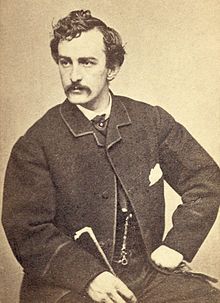
The image of John Wilkes Booth leaping from a theatre box to the stage, and breaking his leg in the process  is imprinted on the historical imagination. It may also be wrong. Having shouted something  - Sic semper tyranis? The South is avenged? A theatre full of witnesses disagree - he walked quickly from the stage through the wings to the stage door, mounted a difficult horse and rode off. The leg was broken, it seems, later on his ride. What else do we picture incorrectly?

Lincoln was only one of the victims on April 14 1865. His Secretary of State Francis Seward was also attacked that night, and left with horrific injuries, while the attacker assigned to Vice-President Andrew Johnson lost his nerve at the last minute. The conspiracy was ambitious in scope, months in planning, had different members coming and in and trying to get out, transformed from a single kidnapping to a planned triple-murder, and yet we only really know one name, that of Booth. And having read American Brutus: John Wilkes Booth and the Lincoln Conspiracies by Michael W Kauffman, I'm not entirely sure Booth would be unhappy about that.  What he would be deeply grieved by would be the high esteem Lincoln is held in today, and why: freeing the slaves, and prosecuting a successful war against the Confederacy. 


Like Bugliosi's book, this is a detailed account of the assassination. As this was a long conspiracy which started before November 1864, naturally the author can't go into hour by hour build up, but for the assassination itself and its immediate aftermath, Kauffman does just that. By the time the other conspirators were tried and hanged it was July 1865 so this book is covering a lot more time in a much more user-friendly length. It is a very readable book, wearing its deep research lightly. Clearly the emphasis is on Booth, his colourful family, his life and motivations. Again there are myths and misconceptions here that Kauffman is keen to clear up. Booth's career was not on the wane, nor was he losing his voice. His plan to kidnap Lincoln and take him to Richmond was a wild one, but not without possibility while the war was continuing. But he dithered so long, Robert E Lee surrendered and people were waiting for the other Southern armies to follow suit. Those who had heard of his plan mocked Booth and his grandiose scheme. The South was falling, Booth was losing face, so out of vanity and bitterness, he crept into the theatre box and shot the President at point blank range.

His other stated motivation was Lincoln's supposed tyranny. And he was not alone in that thought. Suspending habeas corpus and other sections of the Constitution for the duration had made Lincoln some bitter enemies, and more than one of them had wondered out loud and on the record where was the Brutus to stop this Caesar. Booth was consciously following in the Roman's footsteps to save a Republic. But even then he waited too long, by a day. As Kauffman so elegantly puts, it, "Booth had hoped to to kill Lincoln on the Ides and highlight his resemblance to Caesar; but instead he shot him on Good Friday, and the world compared him to Christ."

But Booth's victims went far beyond the President. Any hope of mercy for the defeated Confederacy was gone. Lincoln's wife was eventually committed. Henry Rathbone who was seriously injured trying to capture Booth in the theatre box, went mad with guilt years later, murdered his wife and saw out his days in an asylum. Seward  never fully recovered from his wounds. Booth would write to people with veiled hints, including Vice President Johnson, so as to implicate them in the conspiracy if it went wrong, to the point where lives and careers were damaged and destroyed, and people still ponder if Johnson was part of it. Booth was a vain, calculating and cunning man, who was a successful actor, and a successful assassin, whose actions brought more pain and trouble for the Southern states he was claiming to protect. Sic semper indeed.


Conflicting witness reports, inconsistencies, and coincidences are scattered throughout both the deaths of Lincoln and Kennedy. In one case we don't even consider them important, in the other we use them to create conspiracies to implicate the world. Lincoln died in a simpler time, we in the grip of the parochialism of the present would say, so his death was simpler. Kennedy was our hero, and heroes don't get killed by misfits. Extraordinary men get killed by extraordinary means, vast conspiracies, full of hundreds of evil men. But life is not neat nor well-written. A lone gun nut reaches for his moment, and the rest is history.

Tuesday, October 14, 2014

Born to Rule: Edward VIII


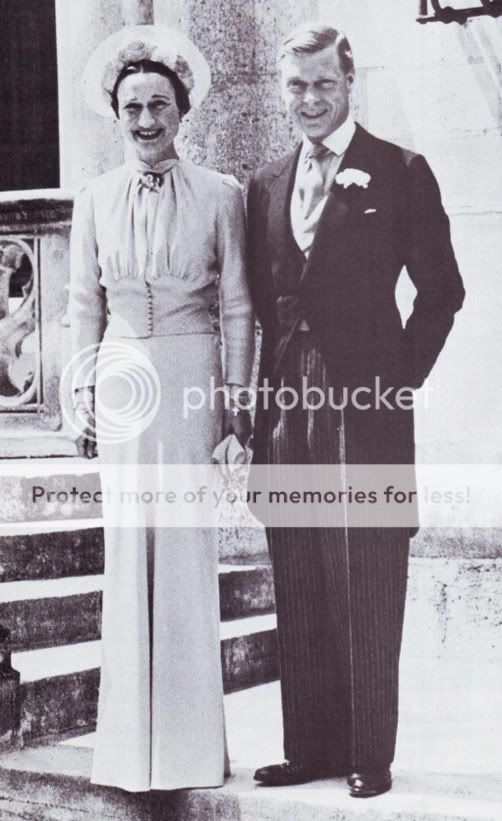
Nice photo-op
There is an air of romance about Great Britain's Edward VIII and fair enough; he did give up the throne for love. Beyond that, my only impressions of him have been garnered from popular culture - a selfish man (perhaps) a womaniser (true, although his marriage was a long and successful one) and nasty to his brother (not true, at least not before or during the abdication crisis: later perhaps) whose life after the abdication did not amount to much (well..) After reading Philip Ziegler's Edward VIII, while I feel more informed, I cannot say I feel much better towards the subject. I do think this is as sympathetic a biography as you're going to get, without lapsing into hagiography. It's a very effective retelling of the Abdication Crisis, which in the end is the most interesting thing about Edward.

 The marriage which was not expected to last - Simpson was not Edward's first great love affair, and the others had petered out -  did so until Edward's death in 1976. Given our next king will be a divorcee married to another divorcee, we can see that time has changed (although whether she will be Queen is still a matter of speculation.) It was Noel Coward who suggested that there should be a statue of Wallis Simpson in every town in Britain, as a tribute to the woman who stopped Edward becoming king. It was a typically waspish Coward thing to say, but contains more than a kernel of truth. A lot of the anger directed towards Simpson derived from her nationality and her marriage status, not to mention her commoner status. But she did seem to bring out the worst in Edward, through her love of money, jewellery, and attention. Not to mention her friends in Germany. But Ziegler dismissed the more lurid rumours about her life and sexuality, simply from lack of evidence.

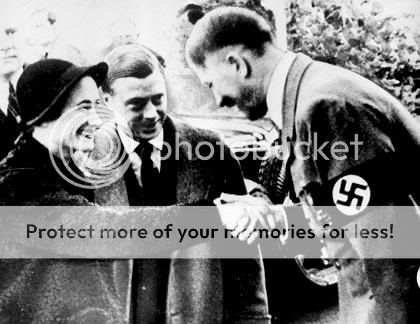
The other use that Edward gets put to in literature is as King of England in the alternative universe where Germany won WWII. Edward, like many of his time, was an appeaser of the Germans and an admirer of the order that the Nazis brought to what had been a country in some chaos. He visited Germany in the late 30s, met the top Nazis, and has been accused of being pro-Nazi.
Ill-advised photo-op
Ziegler seems satisfied that Edward  would not have been a puppet king for the Nazis, should the opportunity present itself. But I cannot help thinking he might have been; not a puppet as such, but he would have seen himself as a mediator between the Germans and the British people. In any case, the point is moot. (In case you're wondering, WE WON!)

This book does spend what seems a lot of time on Edward's youth but I think Ziegler is trying hard to find the boy who became the man who renounced the throne. He felt constrained by his role as a prince, hated the ceremony and dressing up. During WW1, despite being in uniform and asking otherwise, he was kept from the  fighting and spent most of it at one headquarters or another which he resented. (He went on record several times saying how much he hated the Germans; indeed he seemed to share most of the common prejudices of his age.)  He was also aware of the working class and their life and often commented on a need to do something for them. But in the end he lacked the application, and to be fair, the means to do much at all. If he had kept his throne, he may have kicked against the traces but one suspects he would have stayed a conservative course.

 Edward's post-adbication life was about half of his life and yet it takes up perhaps a third of this book, even less, which gives you a fair indication of its action-packed nature. He does well as Governor of the Bahamas during the Second World War, working hard to improve the local economy and the position of the majority black population. But apart from that, most of his energy seemed to be spent on making the Royal Family keep him the style he had become accustomed and trying to get his wife made a Royal Highness. As neither of them were in the line of succession, it seems a fruitless argument. He never seemed to put his energy or his name to anything of use to anyone but himself and his wife.

Possibly from
the Abdication
Crisis
In the end, I kept thinking of what was the point of Edward VIII? If you are born to the royal family, supported by the resources of the people of Britain, and then opt out of what you were born to do, what is the point of you?  Perhaps once he had stopped being king, he should have gone out, got a job, and got on with things as Mr Windsor (or Saxe-Coburg or whatever. Actually, just change his name to Sax Coburg and become a jazz man. Ok, that's a bit silly.) Such a path would be unthinkable then, and perhaps now. But we fetishise self-fulfilment these days to the detriment of everything else - responsibility to others, for example. Responsibility to your society. Edward may have been the harbinger to the modern liberal fallacy that your happiness is the only thing that matters and damn everybody and anything else. Duty, sacrifice, selflessness are all qualities we disparage so we can all be the best you you can be, and I don't see society improving as a result. I don't suggest one should ignore personal fulfilment but I'm not convinced it should be the driver of society that it is. In The Madness of George III, the king's last line (in the film at least) is that the Royal Family is there to be an example. Maybe we all looked to the wrong King.