Showing posts with label Music. Show all posts

Thursday, May 4, 2017

"Will I look back and say that I wish I hadn't done what I did?": Lives of the Beach Boys

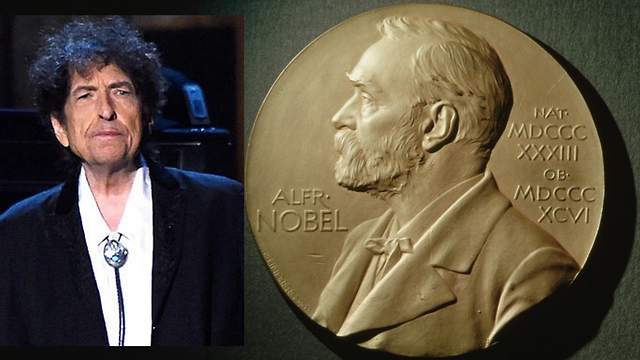
Did you hear? Bob Dylan won the Nobel Prize for Literature, for his lyrics, a decision I’m still not convinced by. I’m not sure how comfortable Bob is with it either, given his reluctance to go and collect the thing. I know a trip to Sweden with a dinner, gold medal and a lot of money sounds horrid but it can’t be that bad.

But I suspect part of his reluctance is part of my discomfort; lyrics aren’t poetry, and don’t operate on their own. They aren’t written to be read or recited but rather sung or listened to. Which isn’t to say a good lyricist isn’t as skilful or artistic wordsmith as any other writer. But for a lyricist words and music, as the old Jo Jo Zep song said, go together. There have been a number of books about music or lyricists that have the words printed but the only way you can really read them is to have the tune in your head as you do so. Otherwise they lose a lot of their life. And while there is no Nobel Prize for music, there’s none for mathematics, art, architecture, engineering, and a whole lot of other human endeavours as well, and it doesn't make them less important.

The interplay between lyric and melody is crucial.  Tim Rice in his autobiography quotes the first verse of his lyric for the tune that became “I don’t know how to love him,” which he maintains would have killed that song dead had it ever been released, despite the melody.  All together now: 

I love the Kansas morning
Kansas dawn comes to greet me
Kansas winds
Shift and sigh
I can see you now, we’re flying high
Kansas love of mine

(It’s a prison song, a man in a jail cell in Maine lamenting his girl back home. Really.) On a more worrying note, George Gershwin’s songs are sung less and less, due largely to his brother Ira’s sometimes twee lyrics, despite the beauty of the melodies. Words and music go together.

Which brings me in a very roundabout way to two autobiographies I have read lately from two of the founding Beach Boys, Mike Love and Brian Wilson, both released in 2016 within weeks of each other. Mike Love is the front man of the band, one of their lyricists, and still goes about with a band called ‘The Beach Boys’, although he is only original one there.
Brian Wilson who wrote, arranged and produced the Beach Boys music, also tours but with ‘The Brian Wilson Band’ as Love has the legal rights to the name. It’s a long story.

The two books couldn’t display a greater contrast. Love’s is chronological, detailed, sometimes to the point of tedium, and I have to say, aimed at scoring and settling points. He feels his part of the Beach Boys’ success has been undervalued both financially and artistically. And to be fair to the man, he’s right. His lyrics on surf and girls was one of the features of their early albums and a big part of their appeal to people who had never seen the beach, leading to their worldwide success. As lead vocalist and front man, he was a dynamic performer. His name was kept off many of the singles for which he was lyricist (by Murray Wilson) and he had to sue to get his rightful recognition and money. Despite his practice and championing of transcendental meditation, he clearly has trouble letting go of years of resentment and anger and it seeps throughout the book.

Wilson’s books is more amorphous, drifting from present to past, in no particular order.  He can go from a description of his current family life to a session of Pet Sounds almost in a sentence. The oldest son of an abusive father, he has famously struggled with mental health and substance abuse issues, and these things affect him still. He finds it difficult to talk about his father Murray, the man who gave him music, who was crucial to the band's early years, but who also beat him and belittled him. His therapist Gene Landy saved his life, but also drugged him, abused him and exploited him. Yet here Wilson is, still writing, still performing but also aware of what his survival has cost. The book can be generalised at times, but at others picks up details and stories that may otherwise have been overlooked. He’s not the most reliable narrator, which he is aware of, but the writing is never confusing, and throughout displays a generosity of spirit that is lacking in Love’s work. 

Love is defensive. Although he is open about his own shortcomings as husband and as a father, as a band member he did no wrong. All those stories you heard about his criticisms of Pet Sounds or SMiLE? “Don’t fuck with the formula”? Never happened. Not one of them. Ever. And so much of the Beach Boys music would never have happened without his magic touch. Just a word, a minor suggestion and near disaster turns into commercial magic. I think he is overplaying his hand. He is also trapped in that idea that good work is commercial work, otherwise it's not good. He's not alone there.

Love’s greatest problem is that he is a classic Alpha male in a situation where he must play second fiddle. While his lyrics work in the main part, that is all they do. They don’t get taken out of the song and quoted, they way Dylan’s do. Or The Beatles. He is a workaday lyricist, successful for sure but no more. Nor as he got older did he ever really attempt to move on from his milieu of beaches and girls. Sometimes it worked - “Do it again”, “Kokomo” - other times it was embarrassing, tending towards creepy - “Hey little tomboy”. Love’s attempt at being political , “Student Demonstration Time”, is likewise painful to listen to, and his song about transcendental mediation oddly jarring. I have read some of his solo work is quite good but I haven’t listened to it.

The greater talent in the band was of course Brian Wilson. His melodies, his harmonies, and his arrangements are some of the greatest in the pop era. What still draws people to the Beach Boys is this music, sometimes in spite of the lyrics. “Don’t Worry Baby” is a stunningly beautiful song - about drag racing. They lyrics here are by Roger Christian, who wrote all the car song lyrics. Other lyricists include Tony Asher (Pet Sounds), Van dyke Parks (SMiLE), himself and other band members. Another big hit "Sloop John B" was a cover of a folk song. As he got older, he pushed himself as a musician, which lead to seeking out new collaborators. Some of his most beautiful work was not commercial but was genuine artistic expression.

In short, Brian Wilson’s successes were not limited to his work with Mike Love. But Mike Love’s success is limited to his work with Brian Wilson, and he resents it.  (Another exception here: "Kokomo" was the Beach Boys’ only number one hit for which Brian Wilson neither wrote or produced.) But at their height of commercial success, Wilson and Love were the core of the Beach Boy's writing. The biggest hit for the band, "Good Vibrations", was a Love lyric to Wilson's music and arrangement. Mike Love has been undervalued for his contribution to the band, and unfairly characterised as the Villain to Wilson' Hero. That said, I think the main difference between these two autobiographies is instructive:  Love admits to Wilson’s talents, while Wilson champions Love’s.

Wednesday, February 11, 2015

Tried to smile, gave it all away? 'Smile' lost and almost found.

There is an excellent series of small books on great or significant albums called 33 1/3.  If you are interested in popular music, you may want to get hold of these. Each album is selected by the author, each with their individual approach and style, reflecting on the album, the artist, and the times they operate in.  With more than one hundred books and counting in the series- from Serge Gainsborough, to Nine Inch Nails, Johnny Cash, Hole, Public Enemy, Flying Burrito Brothers, Black Sabbath and Kanye West - they cover a wide range of style and times. If you feel so moved, you can pitch an album and have a go yourself.

Personally, I have Swordfishtrombones (Tom Waits) ABBA GoldPet Sounds, and Smile (both The Beach Boys) from the series. So far, only the Beach Boys have two albums covered in the catalogue. Even odder, one of those albums doesn't exist. Not really. Which is maybe why it's there.

Smile was the great unfinished album of the 60s. So the story goes, hearing the Beatles' Rubber Soul, Brian Wilson, the composer and producer for the Beach Boys, was inspired to write an album in which every song was good, no filler. The result was Pet Sounds, often held up as one of the great albums. The Beatles' response to that was Sergeant Pepper's Lonely Hearts Club Band, no slouch itself. Wilson went to top that with Smile, a teenage symphony to God, as he termed it. But pressure from his band, himself, his drug-use, his already fragile psyche, and from the industry saw increasingly-eccentric Wilson crack, and put the tapes away, never he said to be used. Wilson himself went into a long period of psychological trauma, from which he emerged periodically only to fall back, until he made a solo comeback, problematic in itself,  in the late 80s. The man back today producing new music, appearing live around the world, is a scarred-survivor.


But some of the songs did come out on other albums; 'Heroes and Villains', 'Barnyard', 'Vegetables', 'Momma Says' 'Wind Chimes', 'Wonderful' and 'Surf's Up', the song that prompted Leonard Bernstein to call Wilson a genius, all made their way onto other releases, some as whole songs, some as fragments. (Van Dyke Parks, Wilson's lyricist for Smile, suggested 'Surf's Up' be put on one album and used as the title instead of the planned Landlocked, and the album should sell a million. He was right.) Wilson's magnum opus, 'Good Vibrations', previously released as a single, was the band's first million seller and was meant to be the album's climax. Why that never happened has been the topic of books, movies, articles and countless discussions and arguments.

The Beach Boys next album instead of Smile was Smiley Smile, which Carl Wilson described as a bunt, rather than a home run. The Beach Boys stumbled ahead of the game here, with an album whose production was simpler and more direct. Dylan and the Beatles were both to offer much simpler albums in its wake. Hopes that Smile would ever see the light of day faded and fans responded with pirated bootleg versions, arguing over which songs would make the album and in which order. My favourite comment of all time, about just about anything on the internet, was one fan who declared, "I don't care what Brian Wilson says, [name of song] was never going to be on Smile!"  If that doesn't sum up the world of internet comments, I don't know what does. 

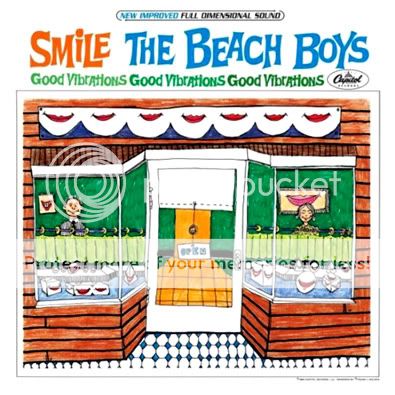
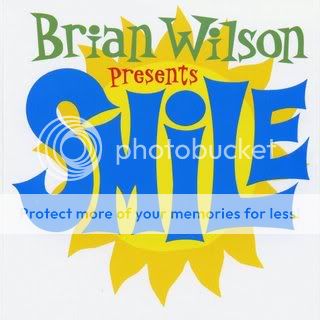
Then in 2004, the unthinkable happened; Brian Wilson toured presenting a live version of Smile, then released a studio album, Brian Wilson presents SMiLE. The arguments started immediately, how much was this the Smile album, really? It was forty years since he had first attempted it, production methods are all so different, didn't he say it should never be released,  the voices were not the Beach Boys, and so on. Indeed, given what had happened to him in the interim, how much was Brian Wilson still Brian Wilson? The album was a critical success, winning a Grammy for Best Rock Instrumental Performance. Then in 2011, the Beach Boys management released The Smile Sessions, doing what the fans had been doing for decades, creating an album from the session tapes. It too was supervised by Wilson but it too is not the Smile album, by definition. In any case, there are now two official versions of an album that doesn't exist.

Being a bit of a Beach Boys tragic, I have both versions in my collection. Wilson's is the better for mine, better finished with a better flow, which only makes sense, as he extensively reworked the material with a band, led by musical director Darian Sahanaja, while Parks reworked the lyrics. The voices are not the Beach Boys, but they're pretty darn good. I can also see why the rest of the band was so worried about it. It is an unusual album, a collection of three suites rather than a traditional pop album. Park's lyrics are poetic, obscure, baroque.  You can hear the influence of Gershwin's Rhapsody in Blue, Wilson attempting to give pop music the same veneer and relationship to classical music as Gershwin did for jazz. The opening number, 'Our Prayer', would not sound out of place next to the 'Humming Chorus' from Madame Butterfly. The album has a ambition and scope that is unmatched in popular music.

In any case, 33 1/3's Smile is an atypical book in the series. Usually, the track by track analysis of the album takes up the bulk of the book. Instead, we have an essay on the Beach Boys and Brian Wilson, the progress of their music and its place in the popular pantheon, as well as an examination of the story and myth of Smile. Only in the last few pages are individual tracks glanced at.  The author Luis Sanchez finds a much more positive story in the tapes from the Smile sessions. Instead of a man falling apart, he hears a man in control of himself, his music and sensitive to the needs of his collaborators. There are other books on the subject that I think are better. As it never actually examines the album itself, it doesn't really fit in with the series. I was disappointed. There is much to discuss with the extraordinary music and lyrics, the differences between the 1966 tapes and the 2004 versions musically, lyrically, as well as the differing track orders proposed by Wilson then and now, but Sanchez does nothing with any of this. It's a missed opportunity.

Why Smile was never finished in 1966 remains a mystery. We can never know what it would have been like, but at least we now have some good educated guesses to go on.

SaveSave

Sunday, May 25, 2014

And his voice may or may not be heard: The intrusive biographers

Byrne's helmet. Compare the description
I've just read Peter Fitzsimon's latest tome, Ned Kelly: The story of Australia's most notorious legend. It's a best seller but I can't think why. While well-researched, it has no new insight into the topic or the people involved. It is written in present tense which according to Fitzsimons gives us the sensation of being there as, apparently, we have never used our imaginations before. If 727 pages of deathless prose like this appeals, by all means read on:

       Undoubtedly the best of the helmets is   the one that has been made for Joe Byrne. In a clever design twist, a curve at the top of his visor reaches down almost to the bottom, covering the exposure of   his nose and leaving his two piercing blue eyes staring out, rather like a bemused koala.

Otherwise, move on. There are many other and better books on Kelly out there.

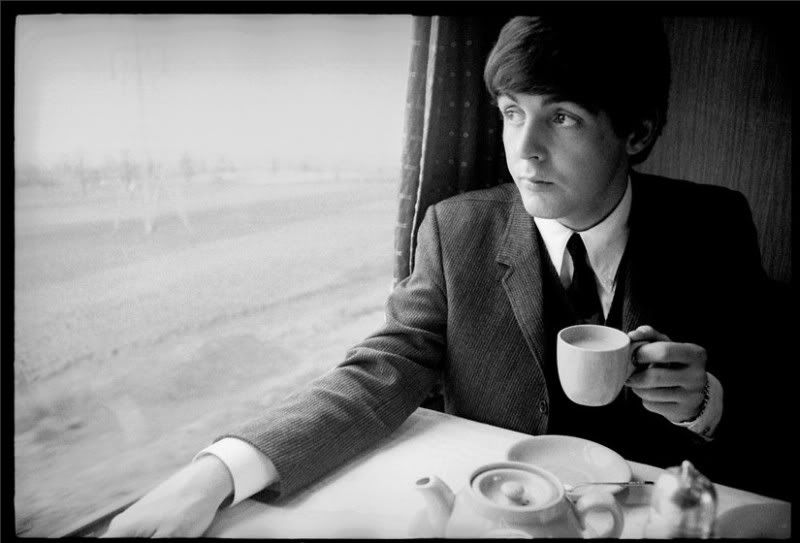
Fab: An intimate life of Paul McCartney  by Howard Sounes is a sometimes sniping tome that again covers well-worn ground without finding anything particularly new.  I'm not sure there is any mystery to Paul McCartney, he's a pretty open book. He has an enviable gift for melody, which even John Lennon acknowledged, even if McCartney's detractors won't. He wrote the most covered song of all time in Yesterday, contributed to some of the greatest songs of modern popular music as part of the most influential rock band of all time, and by all accounts puts on a fantastic live show.

There is a quotation in from David Puttnam that I think does sum up McCartney, comparing him to Ridley Scott 

  [B]oth men of immense, immense, immense talent who on their deathbed are likely to look back on their career with some satisfaction, but with some dissatisfaction, in that I’m not sure that either of them — Ridley and Paul, both very wealthy and everything — I’m not sure either of them has absolutely delivered what was in them. 


Perhaps McCartney's problem was that his songs came too easily, and after Lennon, with rare exception, he never found someone to push him to the heights he was capable of. Mind you, I'd say the same about Lennon, who was a more interesting lyricist, but didn't always avoid the issue of disappearing up his own arse.

On the other hand, would McCartney care? By any definition he's had a successful and happy life, marred with the loss of his first wife and a failed second marriage (which this book dwells on to a distasteful degree) and of course, the loss of the friends of his youth and the partners of his extraordinary early success.  He's lived most of his life in the public eye and with astonishing riches. He's been very generous to his family, his home city and friends. And his children all seem quite happy and down to earth. That's a great success there.

Both these biographies suffer from the current affliction, that is the intrusive biographer, which is quite the trend. When I read a biography, I like to think I have heard the voice of the subject and not the author. Jim Henson: the Biography by Brian Jay Jones, is much closer to the old-fashioned style of biography and is all the better for it. By its end, I felt I had learned much more about Henson, and that, however at a remove, I had spent some time in his company. Which by all accounts was a pretty good place to be. This is an authorised biography but I cannot imagine anyone but the most perverse biographer finding much dirt on Henson. His creativity, his supportiveness, his curiosity, his optimism are all in plain view in his work.  And his influence goes on today. I'm sure I am not the only person in the world who knows his outlook on humour and life is indebted to both Sesame Street and The Muppet Show, as well as so many other projects. And who but perhaps George Lucas would prefer the CGI Yoda to the original puppet performed by Frank Oz?

Some years before his untimely death Henson wrote two letters to his family to be read after his death. (In one letter he said it felt an odd thing to be doing, but would be much more difficult once he had died.)The second ends like this:

Please watch out for each other and love and forgive everybody. It's a good life, enjoy it.


Now that's a man whose voice is worth hearing.

Tuesday, July 2, 2013

"Where's Eddie?" - Eddie and the Cruisers


Some excellent films have been made of B-grade novels, while some truly terrible films have come from excellent novels.  Truffaut said something like a work of genius is an idea that has found its ideal form of expression. Which may explain why good novels make average films and vice versa.

Eddie and the Cruisers was a failure at the box office but has become something of a cult classic. My brother introduced me to it many years ago. It features Michael Pare as Eddie Wilson, a combination of Jim Morrison, young Elvis Presely and Brian Wilson, and Tom Berenger as Frank Ridgeway, or Wordman, a college kid who ends up the band’s lyricist and keyboard player. After the Cruisers hit the big time with their first album, Eddie is killed in a car crash. The story takes place two decades later, when interest in the Cruisers is revived and someone is tracking down Eddie’s lost tapes, the rumoured second album, and isn’t afraid to kill to get them. It’s a good movie and the music is good even if it rather sounds like what Bruce Springsteen was doing in the 80s rather than rock of the 1960s. (Do us all a favour and avoid the sequel, Eddie and the Crusiers II: Eddie lives! That exclamation mark is a shriek of disappointment.)

I was surprised the other day to walk into a library and see a new edition of the novel, by P F Kluge, sitting on the shelves. One, I didn’t know it was a novel and two, it seemed a bit odd to bring it back. So I borrowed it and have come back to tell you all about it.  It’s not a bad read. The movie kept pretty close to the story, although they have softened it somewhat. The novel is darker and more violent, but I think the scriptwriters made the right call there. I don’t think the tone of the novel and the stakes quite justify the violent ending of the novel, and suit better the pathetic villainy of the movie. But the novel is a loving tribute to the music and the power of the music of the early 1960s, and the terrible power of youthful dreams. The Maguffin of the lost tapes, with the surname, makes me fairly certain that Brian Wilson and the long lost Smile album form part of the inspiration for the Eddie Wilson character, while his sexy onstage persona and reaching for philosophical insight brings to mind the lost Jim Morrison. Perhaps it’s all a bit of anachronistic jumble of rock heroes but it seems to me that’s the nature of popular music, someone new who reminds you of someone else.

Anyway, I had an enjoyable few days reading the book and even ordered a copy to be sent to my brother for his birthday. If he hasn’t got it yet, and this is the first he knows about it – happy birthday AB!

Saturday, January 7, 2012

"The mystery of things." Bomber Harris, Orson Welles and Tom Waits - together at last!


Biographies have changed. Like other history books the authors aimed for a impersonal detached and objective tone. Now, with changes in taste and philosophies, the authors’s voice has become much more idiosyncratic and for mine, obtrusive. When Pamela Stephenson, for example, is writing about her husband Billy Connolly, such a personal approach may be justified. But many biographies these days seem to be written in a much more direct even chatty style, even when they don’t enjoy such a personal relationship with their subject.

The three latest biographies I have read have spread across the gamut of modern biography. One is old-school objective, another focussing on one section of its subject’s career, and the third an unauthorised biography of a still-active artist covering his entire life.

The first was Bomber Harris: His life and times the life of Arthur Harris, who led Britain’s Bomber Command during World War II. Harris still a controversial figure and Bomber Command’s tactics are still the cause of argument. But from Dunkirk through to Normandy, bombers were the only way Britain could fight against Nazi Germany and give support to the Russians on the Eastern Front. After the war, Albert Speer, Hitler’s Minister of Armaments, said the damage done by the bombers, the extra guns and troops stationed in Germany to combat them, was as effective as a second front and a large part of the reason Germany lost. This still leaves plenty of room for arguments about tactics and strategies, and morality.

There is no easy answer but the author fairly lays out the facts, opinions from others from the era, and gives differing conclusions from other historians, while presenting his own findings. In the end we get a pretty clear picture of the man both as a person and as a military commander, his strengths and his flaws. If the book is somewhat dry to read, and does get a bit bogged down in detail, it does what it sets out to do: tell the life and character of Arthur Harris.

The second book is not quite a biography but I’m not sure what else to call it. Clinton Heylin’s Despite the system: Orson Welles versus the Hollywood Studios examines the Welles’ Hollywood career, from Citizen Kane through to Touch of Evil from when he had complete control of his film to becoming a director for hire. Here the author is not afraid to make his voice heard at all and is quite scathing about a number of previous biographies of Welles, as well as praising a few others. He is especially scathing on half-arsed psychological assessments of Orson Welles that ‘explain’ the number of films he did not finish. By contrast he shows the hurdles the Welles had to overcome in terms of budgets and studio politics. These are real, identifiable and demonstratable. And as an explanation of Welles’ career, much more satisfying.

Welles’ personality of course did not help him in playing studio politics. He was never afraid to call a shovel a shovel or an idiot an idiot. He did have a tendency to indulge himself at some expense to his employers. But he deserved better than what he got. Welles’ control of his film Kane was unprecedented but now it is not uncommon. Directors now have complete control of their films and what do we get? More Kanes? No, we get “Indiana Jones and the Kingdom of the Chrystal Skulls” and the Star Wars prequels. It takes more than total control to make good art

Heylin also gave me an insight into Welles’ films I had not had before. Welles’ is a Brechtian film-maker, drawing attention to the techniques of film as you watch it. Also, as a result of his work on radio, he had a much more interesting and integrated approach to the use of sound in film. Even today he would still be a radical in Hollywood. When he was able to get these factors together, it made Welles’ films identifiable almost at a glance – and a listen.

He also puts to bed, for mine, the theory that Welles did not write Citizen Kane, but rather, at best edited what Herman J Mankiewicz wrote. Simply put, Mank’s scripts before and after Kane was formulaic pot-boilers. Welles on the other hand was making films that challenged Hollywood’s aesthetic, narratives and techniques for the rest of his career. Welles was always ready to give Mank credit when it was due, the  ‘Rosebud’ Macguffin but one example. It’s time some of his detractors gave Welles the same courtesy.

The next in this biographical triumvirate is Low side of the road: The life of Tom Waits  by Barney Hoskyns. I am an enormous fan of Waits, the wide range of his musical styles and his fun, provoking, often moving lyrics. Hoskyns is open about the music he likes and the music he finds not so essential. He is also ready to admit that others may disagree with his assessment - a radical approach for a critic. This is an unauthorised biography which often means a hatchet job, but not in this case. This is an admiring biography, while not shying away from aspects that Hoskyns does not find as admirable. It’s an entertaining and informative read. I was delighted to read that all the idiosyncratic names that pepper Waits' work are from people he has known.

Waits has lead an interesting life both professionally and personally. But unusually for these times, he keeps his private life very private. He also believes that an artist’s work should speak for itself and not be interpreted through the narrow lens of autobiography.  This is part of what makes Waits such an oddity. All art is supposed to be confessional and revealing one’s private life is supposed to be a sign of honesty. Both these ideas, though popular, are questionable. (Incidentally, Arthur Harris declined several offers to write his autobiography. He thought he had said quite enough on the subject.)

Waits and his wife and collaborator Kathleen Brennan asked people not to talk to Hoskyns, and Hoskyns is quite open about that. However a number of people did speak to him, and Waits himself has a sheaf of interviews published over the years, including several with Hoskyns and the result is a good read, a good biography. Once again, it had me going back to the music to listen to it with new ears, always a good sign.

Three books, three different approaches. All three are worth reading, but do any of them crack the mystery of their subject? Ultimately no. Where talent for music, film or leadership comes from is unsolvable. Welles and Waits have given us great art, Harris is one of those responsible for our freedom. They are imperfect as we all are. Perhaps in the biggest terms, biographies are another tool in our ongoing attempt to make sense of human existence and the meaning of life. Or perhaps we just find people interesting.

Wednesday, September 7, 2011

"The #!@ing words are awfully strong." Stephen Sondheim

The Canadian political writer Mark Steyn, who has a background as a theatre critic, says Stephen Sondheim doesn’t fit into the great American songbook tradition, as it is impossible to sing his songs in any other way that the way he wrote them. And when you see singers doing Sondheim songs, they always do them with the same tempi and in the same style as he wrote them.  You rarely hear jazz singers toy with the melody and pace of a Sondheim song as they do with, say, a Cole Porter.

Sondheim I suspect would take this as a compliment. Whereas Porter, Berlin, the Gershwins were by and large writing for the hit parade, with the particular show the means of delivery, Sondheim is very much writing for the moment and the character in the show. This is as much because of his aesthetic as it is because of changing times and expectations. So if his songs are difficult to understand out of context, and difficult to ‘re-interpret’, Sondheim would say he is doing his job.

(While I’ve got you here, I do find the habit of jazz singers of taking a classic song that we all love and thinking ‘You know, I think this would be improved with a different melody and a different rhythm and hell, a few extra lyrics. What did Porter know?” a bit odd, to say the least. Perhaps I am yet to hear a superb jazz singer, which is entirely possible.)

While Sondheim is currently a gold standard of modern Broadway, he is, like the gold standard, getting on. There have just been celebrations for his 80th birthday, and as someone said, one feature of old age is a tendency to reminisce, what has also been called our anecdotage. When someone like Sondheim starts to reminisce, the best thing to do is encourage him.

And so we have Finishing the Hat: Collected Lyrics (1954–1981) with Attendant Comments, Principles, Heresies, Grudges, Whines and Anecdotes by Stephen Sondheim. This covers Sondheim’s career up to ‘Merrily we roll along’. Each chapter begins with a short essay on the provenance and history of each show. Then we have the complete lyrics, often with deleted lines, cut songs, and alternate materials included. And this is all sprinkled with commentary and anecdotes about performers and collaborators, as the title suggests. A second volume, Look I made a hat, taking the story up to 2011, is in the pipeline.

The endpapers are decorated with Sondheim’s three great principles: less is more, God is in the details, and content dictates form. All of which he explores in the body of the book.

Lyrics, Sondheim insists, are not poetry. This will find disagreement in those who want to push the likes of Paul Kelly, or (God forbid) Jim Morrison as poets. But, as Sondheim discusses, poetry is read at one’s own leisure whereas lyrics work with music defining the timing, pace and time you have to take the words in. If your songs are part of a show, there are even more constrictions. Therefore, the demands on the words are very different. Putting poetry to music is fraught with peril, you either work against the rhythm of the poet, or are trapped by it. By the same token, lyrics without music can be a bit flat and uninvolving. It is the relationship between the words and the music that gives lyrics their power.

And he is very particular about what makes a good lyric. Whatever else Sondheim does with words, he does not mince them. In sidebars on other lyricists, he is not afraid to criticise the greats, from Ira Gershwin to Alan Jay Learner to even his own mentor, Oscar Hammerstein.  He believes his pastiche of W S Gilbert’s lyrics in ‘Pacific Overtures’ is better than Gilbert. He praises too, often the same writer. Sometimes these are an aesthetic judgement, other times technical, sometimes bordering on the pedantic, but always well-argued and based on principle. And he is not averse to bringing this judgement on his own work.

His dislike for his work on ‘West Side Story’ is fairly well known. “Somewhere” he recalls as the “a” song, as that’s the word given an entire bar on the highest point of the melody as if it meant something. “I feel pretty” has a Puerto Rican Girl making sub-Cowardian internal rhymes. (He doesn’t like Coward’s lyrics too much either, for that matter.) But his self-criticism lasts into later and more mature work. So if you’ve picked a flaw or two in a Sondheim lyric, I suspect he got there first.

If you’re interested in musicals or writing, this is definitely worth a look. It’s an expensive book (I bought mine online, again a LOT cheaper) but it’s a book I can see myself going into over and over. What can I say? God knows how fond I'm of Sondheim.

Wednesday, August 17, 2011

"Come sing a song of joy my brothers." The Bee Gees


I have a friend who for all her positive qualities has trouble telling stories. Not that her stories aren’t entertaining but she does tend to think every detail is equally important. Which can bog the stories down a bit, or muddle the point. Still it’s a minor fault, particularly as I don’t see her too often and I enjoy her company. Indeed, as she is aware of this aspect of her story telling it’s often charming and fun.

I thought of her as I waded through The Ultimate Biography of The Bee Gees: Tales of the Brothers Gibb by Melinda Bilyeu, Hector Cook, and Andrew Mon Hughes, with assistance from Joseph Brennan and Mark Crohan. It was with some trepidation I took this book down from the shelf in the library. There are three Bee Gees and they have had a long career from early teenage years to the death of Maurice in 2003, which effectively ended the band, but still the book seemed inordinately large. Was there that much to be said about any pop group?

To begin with, I was pleasantly surprised. Before the second chapter was over, both Barry and Maurice had almost been killed in childhood accidents, both before they were two.  Later on, Robin is almost wiped out by a truck. And they become youthful vandals and troublemakers. This was evidently a story fraught with incident and accident and who knows what else.

But then the story slowed down bogged in unimaginable detail. The Bee Gees started performing as children and their career continued for five decades. They also had a career as song writers, a career that started early and continued alongside their performing careers. It’s an important facet of their story. More than once, Barry Gibb and the others have said they would rather be remembered as a songwriters than pop stars. If you doubt me, read this book. This gets stated at least five times.

In addition we get a potted history of just about every band that ever recorded a Gibb Brothers song. Or played with the Bee Gees. Or musicians who played a gig in the Bee Gees band then went on with their own lives.  Not potted in a sentence but in at least two or three paragraphs. And the vast majority of pop bands disappear without trace, so this is tedious detail on bands you never heard of. 

And all incidents seem to require the viewpoint of all three brothers at least, if not their wives, families and business associates. Which might be useful if these views were substantially different but often they’re not. It’s more often reiteration than clarification or diversification. It’s like watching those all-star films where the contract states they all get equal screen time.

And we get press releases and statements, not summarised or effectively quoted but quoted in full. For example, Robin moves to the country with his wife and buys a dog, and as pop stars do, makes a statement about it. This may be of interest to fans, and the private life of one of the Bee Gees is fair fodder for a book like this. But do we need three paragraphs quoted in full on the dog taking to the country life? Wouldn’t one sentence do?

Not that this is not a story without interest. Three brothers creating a band and a sound that lasts for decades, producing some of the great pop songs, with break-ups, arguments, triumphs and low points, personal tragedy, there is a lot to be enjoyed here. (And compared to another family band, the Beach Boys, the Bee Gees are the Brady Bunch.) Meanwhile, their song-writing abilities alone deserve respect. They once wrote three number one hit songs in a fifteen-minute session. We learn their method of working, keeping rhythm by slapping their thighs, they set the melody first and never deviate from it, which may account for the tortured syntax some of their lyrics can have. This should be a scintillating and insightful read. But the book betrays its origins. It’s written by a committee (this approach worked once, with the King James Bible, and never since) and started life as a blurb for a program for one of their concerts. You’ve read one of those blurbs. Now imagine that going on for 700 pages. Not that it’s a hagiography. The band and its individual members get criticised and this is reported fairly.

Its major fault is a lack of editorial nous. There is no sense of what the authors are trying to do except get every thing they know about the Bee Gees into one book. Statements and information is repeated. One wonders if there was a final edit. This book is probably very useful as a reference book but as a read it’s tedious. The index is quite good. This is not damning with faint praise – lack of a good index has ruined many a good non-fiction book.

I wish this book was better than it is. I enjoy the Bee Gees’ music and in interviews they come across as entertaining and fun. The ultimate biography, despite the title here, is yet to be written.

Tuesday, July 12, 2011

"Enemy coast ahead." The Dambusters

As I mentioned earlier, more information is forthcoming about World War Two, as more information becomes declassified and more sources are made available. But some sources are becoming more scarce. I refer to the veterans themselves, both combatants and non-combatants, military and civilian. Historian Max Arthur is aware of this and is publishing oral histories of the world wars, combining published sources and new interviews to bring us their stories in their own words. Such primary sources are invaluable, and offer an insight obviously unavailable in any other way.

Arthur’s lastest book is Dambusters the story of perhaps the most famous aerial attack in WWII when 617 Squadron attacked three major dams in Germany using Barnes Wallis’  ‘bouncing bomb’. The raid has already been a book, by Australian Paul Brickhill as well as a movie, both called ‘The Dam Busters.’ The name of their first raid stuck to the squad through other astonishing missions of precision bombing.  But this book gives us the story through the pilots, the crew, the ground crew, the scientists, and the civilians who lived underneath the dams themselves. It’s an interesting, affecting read.

The campaign by Bomber Command from 1939-1945 has been the subject of some controversy, particularly the further we get from the war itself. Some have said the area bombing of major German cities was a war crime, some even going so far as to compare it to the Holocaust. While the latter comparison is as silly as it is offensive, the overall question does deserve some attention.

My reply is always, what else were they to do? Britain had no other way to fight back against Germany except through Bomber Command. Speer, the organising genius of the Reich, said the bombing was like a second front. In using artillery, troops, aircraft, and other resources for defence and rebuilding, it was impossible for Germany to turn its full might on Russia. The Eastern front was a brutal, ugly, protracted fight – and a near thing. If Germany had been able to keep minimum resources at home and on its Western defences, who knows what may have been the result.

That said the campaign was not beyond criticism. If Arthur Harris had backed the Mosquito instead of the Lancaster, precision bombing using much lighter loads and fewer crew for better results might have resulted, with fewer civilian casualties. But this is decision much easier to see from here, and not from then, when aerial bombing was still a new tactic, subject to much argument. Certainly it can be argued that Harris continued with area bombing when other tactics were available.

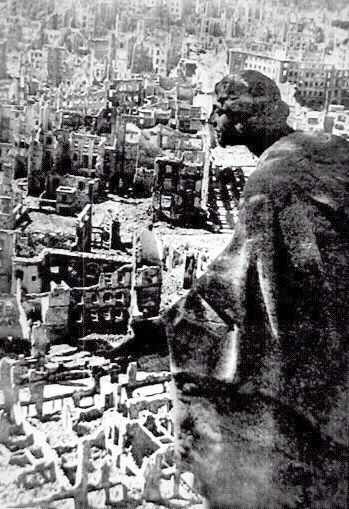
The bombing of Dresden in February 1945 by British and American crews is still a source of controversy. For some time, details came from the Nazis, and then the USSR, both of who had an obvious motivation in making the Western Allies look as bad as possible. The city was a major junction for troops heading for the Eastern Front, and the attack was in part requested by the Soviets, who for decades denied such a request existed. It was also the site of factories making parts for bombsights for German bomber, making Dresden as legitimate a target as any other city.

The story of Dresden as a source of shame for the allies was propagated by David Irving. Irving based his figures for civilian casualties on a German source, which was later shown to have been forged, the figures exaggerated by a factor of ten. Nearly twenty thousand casualties became 200 000. Irving also included stories of Allied fighters attacking refugees, for which there was no credible source. Irving’s great shame, and evidence of his lack of credibility, was that once the forgery was discovered, he kept quoting the false figure, even through later editions of his book.

But let’s not forget the 20 000.  Dresden was not the most severe raid of the war, but it was late in the piece with Germany on the edge of defeat, and while not a war crime, it could well be morally questionable. I suspect WWII had the greatest parity between civilian and military casualties of any war to that time, and mainland Europe took the greatest brunt of that. The line between civilian and soldier had been blurring through some years and advances in technology, and the bomber erased it completely. You should read Frederick Taylor’s Dresden: Tuesday February 13 1945 for a balanced assessment.

In any case, the argument about Bomber Command should take nothing away from the courage, skill and sacrifice of the young men in the airplanes.

Meanwhile the Dambusters raid was an astonishing feat of visionary engineering combined with courageous and superb flying, and worth revisiting. Peter Jackson is working on another big screen adaptation, with Stephen Fry writing the script. Recently it was announced that the dog belonging to Squadron Leader Guy Gibson would be called ‘Digger’. It seems a small point, but the dog died the night before the raid, and in memoriam, his name used as the codeword for a successful breach of a dam wall. So what? In reality, the dog’s name was Nigger, and this was the codeword that captured the great moment of triumph. (Yes the dog was black – Gibson had many positive qualities but racial sensitivity or a sense of irony was not among them). Fry was immediately accused of rewriting history. But again I ask, what else could they do? Even in the 1954 film, the name was dubbed ‘Trigger’ for the American release, and to use the N word, however accurately, in a 21st century film is commercially unthinkable. And phonetically, Digger is the better substitute, the tongue being in a very similar position on the hard ridge of the palate for the /d/ phoneme as for the /n/, even if the soft palate is doing something altogether different. Perhaps instead of the Director’s Cut DVD, they could release the Historical Stickler’s Cut with the dog’s real name dubbed as necessary – and a prominent offensive language warning.

Meanwhile, surely they won't touch the music?

Tuesday, June 21, 2011

"Look at me Leonard." Leonard Cohen

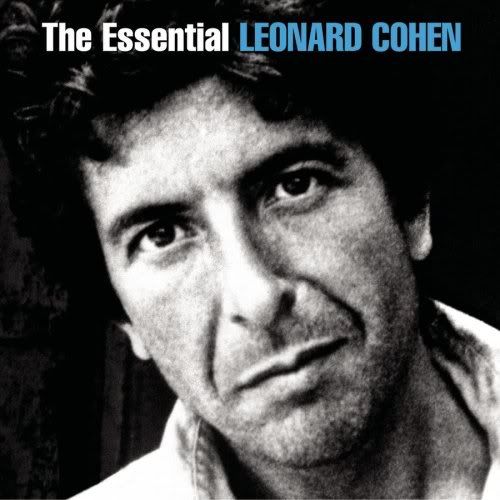
I have a friend, a professional musician (actually he’s a drummer, but I leave the jokes to you) who is (and this will be no surprise really) passionate about his music. I told him I had bought the Essential Leonard Cohen double CD. He said, ‘If you can find a dud track on that album, I’ll bash your face in.’ Luckily for my face, I found no dud track. (And yes, we’re both old enough to remember what an ‘album’ is.)

I was also lucky enough to see Cohen live on his latest tour. It was one of the greatest nights I have spent in a theatre. I have never seen a performer so free of ego. When Cohen gave the focus to the musicians or singers, he did not just step back but disappeared into the shadows. He genuflected to the audience and to his fellow musicians frequently, and seemed genuinely touched by the love that flowed from the crowd. When he played the simple one-fingered piano solo from ‘Tower of Song’ the crowd went nuts. His response: ‘You’re too kind.’ He is I think truly humble, in the correct sense of the word, one who knows his place in the world and the universe. In his 70s and after an almost three hour show, he literally skipped on for his encore.

I finished reading Anthony Reynolds’ 2010 biography Leonard Cohen: A remarkable life one Sunday morning and spent the afternoon listening to his music, performed by him and by Jennifer Warnes, KD Lang, Joe Cocker, Aaron Neville, John Cale, Nick Cave and the Klezmer Conservatory Band, among others. It was an afternoon well spent, and testament to the quality of this biography that it sent me back to the music. Had I Cohen’s poetry or novels to hand, I might well have gone there as well.

Cohen’s career began as a poet and novelist before he turned to music in the 60s, had almost petered out in the 80s but then came back with astonishing music. His fellow musicians have always respected his writing, with many cover versions done from his first album onwards.  Starting from the early 90s, his song ‘Halleluja’, almost overlooked on release, was everywhere. When his manager stole most of his money earlier this decade, he came back with a tour that is still going, cementing his place not as a nostalgia act but a musician and writer for our times.

He has always been ready to work in partnership with other composers, singers and musicians, who speak highly of him. The only person who seems to have a grievance is the Steven Marchat, the son and partner of Cohen’s manager Marty Marchat. They had a falling out over money and, it seems, Cohen’s reluctance to talk to Steven about his father. But even he concedes he likes Cohen.

Cohen has been called music to slit your wrists by, but this is an unfair, perhaps lazy, generalisation. His lyrics are much more literate and evocative than your average rock song, direct yet mysterious, and not without humour. His melodies are suited to his limited range so perhaps he is not the most melodic of writers, but songs such as ‘Hey that’s no way to say goodbye’ show he can write pretty melodies within these limitations. He self-deprecatingly referred to his gift of a golden voice, but as he has gotten older his unique (!) voice has gained depth, to the point where he sounds like an Old Testament prophet, if one was going to sing popular songs. It’s music that engages the mind as well as the ears.

It can also touch the soul. Cohen’s lyrics often reflect his spiritual journey. Cohen is a Buddhist monk but also a Jew who still has his traditional Friday night meal with family and friends. He has investigated and explored many of the major religious traditions and some of the more obscure ones. As he says in concert, “I have spent much of my life studying the great philosophies – but cheerfulness kept breaking through”. I think the nearest he comes to a single religious viewpoint in his song ‘Anthem’: There is a crack, a crack, in everything/ That’s how the light gets in.

He also writes with equal openness about sex and food and drink and women – especially women. On his latest album Dear Heather he says ‘Because of a few songs/ Wherein I spoke of their mystery/ Women have been exceptionally kind/ To my old age.’ From Suzanne on his first album to Heather on his last, women have been important figures in his songwriting, and his lyrics exploring this fascinating topic range from the mystic to the earthy, poetic and frank.

Which is why, I think, ‘Halleluja’ has become THE Cohen song. To me, it’s about a great love affair that had the intensity of religious ecstasy, which is now finished but has left the lover in a state of battered gratefulness. The two great themes of Cohen’s work come together in a song fusing the sensual and the spiritual into a coherent whole.

There is a crack in everything. Cohen’s money was stolen by his manager, which has forced him back on the road and back into the studio, which has given hundreds of thousands of fans the chance to see him live, for him to enjoy the love of his audience, and new music for the world. If you want it to put this down to the mysterious movement of God, or just a lucky variation of shit happening, I don’t care. It is a gift. Light got in.


PS Mark Steyn has just written a column this week on 'Dance me to the end of love', placing it within the great American songwriting tradition. It's worth a read.

Thursday, May 5, 2011

"Fools like me" Poetry

 The literary world should take warning– I have started writing poetry again. I’m not entirely sure why as I haven’t written any poetry for some years. Perhaps it is just that I am writing more these days as a result of my blogging and other activities so that part of my brain, or my soul, has reactivated.  Whether I shall publish those poems here, or anywhere else is another matter, but it’s doubtful. Poetry can often just be another way of talking to yourself, so perhaps I am my poetry’s only appropriate audience.

My friend’s mother is a retired English teacher. I was working at a school at one time where the Grade Eight classes (12-13 yr olds) would rotate and so one teacher would teach the one unit to the four or five classes that made up the year, and I was teaching poetry. She said if her school had that system, she would choose the poetry unit. She loved, as I recall her telling me, introducing students to the uses of poetry. She would show them the Memoriam section from the paper to demonstrate how poetry worked: when our emotions go beyond mere words, we resort to poetry. Those columns were full of poems, original and copied, written and placed by people trying to cope with grief. I immediately stole that idea for my own classes. It was also her that introduced me to Yeats – and I never thanked her.

Poetry is a complex beast. In the twentieth century it underwent the same process as some of the plastic arts. Poems went from formal structured affairs to whatever collection of words spilled any which was onto the page that you nominated as a poem. Which, like most changes in life, was a change for better and for worse. Structure did not save us from bad poetry, and more free form poetry does not prevent good poems being written.  But I do admit a preference for more structured poetry. I think the extra rigour involved in following forms tends to produce better poems. Do read Stephen Fry’s (look him up if you don’t know who he is) The Ode less travelled for an informative ‘How-to’ on poetry forms.

Another side-effect of my poetry writing is that I finally got around to reading a book I bought ages ago, How to read a poem: And fall in love with poetry, by Edward Hirsch. It is a wonderful book and reopened my eyes and ears and heart to poetry again; I can put it no other way. Like Dickens, poems - even short ones - demand our full focus. Hirsch, a professor of English, critic and poet himself, takes us through various types of poetry and his passionate response to them. His responses are so detailed and loving it creates a need in his reader to read poems again to try to bring their own response to a similar level. His examples are wide ranging in time and style and most pleasingly for me, languages. Translation is a difficult art, and poetry trickier than most, but it was a pleasure to be introduced to a group of poems, poets and traditions of which I had been unaware.

Hirsch quotes Ezra Pound, “Emotion is what endures.” Certainly the poems that we remember, that come to us in half-remembered fragments in moments unprepared, are the ones that struck a chord in us when we read them. And the best poetry I think still maintains its links to the vocal tradition and responds well to being read aloud.  I am reading Robert Fangles’ translation of the Iliad at the moment and it screams to be read aloud and so at times I do. Not a bad way to practice diction either. And to feel those words and phrases in your mouth is to be part of a tradition, and a joy, that dates back millennia. Of course, the Iliad comes directly from a vocal tradition but Yeats, Frost, Cavafy, Hughes, Dawe, Oodgeroo and Heany all reward reading out loud. And that’s just a sample off the top of my head, there are thousands more.

And the lyric poem, which came from song , can lead back again. Here is Constantine P Cavafy’s The God abandons Antony. Antony thought himself under the protection of the god Bacchus. At midnight before Octavian’s final attack on Alexandria and Antony’s death, a Bacchanalia passed by Antony’s window, which the historian Plutarch saw as Bacchus leaving Antony to his fate. Cavafy’s narrator watches Antony as the procession passes:

When suddenly, at midnight, you hear
an invisible procession going by
with exquisite music, voices,
don’t mourn your luck that’s failing now,
work gone wrong, your plans
all proving deceptive—don’t mourn them uselessly.
As one long prepared, and graced with courage,
say goodbye to her, the Alexandria that is leaving.
Above all, don’t fool yourself, don’t say
it was a dream, your ears deceived you:
don’t degrade yourself with empty hopes like these.
As one long prepared, and graced with courage,
as is right for you who proved worthy of this kind of city,
go firmly to the window
and listen with deep emotion, but not
with the whining, the pleas of a coward;
listen—your final delectation—to the voices,
to the exquisite music of that strange procession,
and say goodbye to her, to the Alexandria you are losing. 

Leonard Cohen, who started life as a poet and whose lyrics are haunting and mysterious yet direct, took this poem and adapted it into a song about the end of a love affair:


A cycle of beauty, a coming together of history, poetry and music, myth, and emotion. Whose heart could this not move?