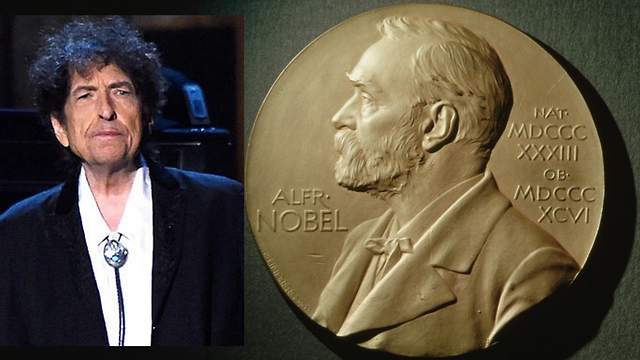
But I suspect part of his reluctance is part of my discomfort; lyrics aren’t poetry, and don’t operate on their own. They aren’t written to be read or recited but rather sung or listened to. Which isn’t to say a good lyricist isn’t as skilful or artistic wordsmith as any other writer. But for a lyricist words and music, as the old Jo Jo Zep song said, go together. There have been a number of books about music or lyricists that have the words printed but the only way you can really read them is to have the tune in your head as you do so. Otherwise they lose a lot of their life. And while there is no Nobel Prize for music, there’s none for mathematics, art, architecture, engineering, and a whole lot of other human endeavours as well, and it doesn't make them less important.
The interplay between lyric and melody is crucial. Tim Rice in his autobiography quotes the first verse of his lyric for the tune that became “I don’t know how to love him,” which he maintains would have killed that song dead had it ever been released, despite the melody. All together now:
I love the Kansas morning
Kansas dawn comes to greet me
Kansas winds
Shift and sigh
I can see you now, we’re flying high
Kansas love of mine
(It’s a prison song, a man in a jail cell in Maine lamenting his girl back home. Really.) On a more worrying note, George Gershwin’s songs are sung less and less, due largely to his brother Ira’s sometimes twee lyrics, despite the beauty of the melodies. Words and music go together.
Which brings me in a very roundabout way to two autobiographies I have read lately from two of the founding Beach Boys, Mike Love and Brian Wilson, both released in 2016 within weeks of each other. Mike Love is the front man of the band, one of their lyricists, and still goes about with a band called ‘The Beach Boys’, although he is only original one there.
 The two books couldn’t display a greater contrast. Love’s is chronological, detailed, sometimes to the point of tedium, and I have to say, aimed at scoring and settling points. He feels his part of the Beach Boys’ success has been undervalued both financially and artistically. And to be fair to the man, he’s right. His lyrics on surf and girls was one of the features of their early albums and a big part of their appeal to people who had never seen the beach, leading to their worldwide success. As lead vocalist and front man, he was a dynamic performer. His name was kept off many of the singles for which he was lyricist (by Murray Wilson) and he had to sue to get his rightful recognition and money. Despite his practice and championing of transcendental meditation, he clearly has trouble letting go of years of resentment and anger and it seeps throughout the book.
Wilson’s books is more amorphous, drifting from present to past, in no particular order. He can go from a description of his current family life to a session of Pet Sounds almost in a sentence. The oldest son of an abusive father, he has famously struggled with mental health and substance abuse issues, and these things affect him still. He finds it difficult to talk about his father Murray, the man who gave him music, who was crucial to the band's early years, but who also beat him and belittled him. His therapist Gene Landy saved his life, but also drugged him, abused him and exploited him. Yet here Wilson is, still writing, still performing but also aware of what his survival has cost. The book can be generalised at times, but at others picks up details and stories that may otherwise have been overlooked. He’s not the most reliable narrator, which he is aware of, but the writing is never confusing, and throughout displays a generosity of spirit that is lacking in Love’s work.
Love is defensive. Although he is open about his own shortcomings as husband and as a father, as a band member he did no wrong. All those stories you heard about his criticisms of Pet Sounds or SMiLE? “Don’t fuck with the formula”? Never happened. Not one of them. Ever. And so much of the Beach Boys music would never have happened without his magic touch. Just a word, a minor suggestion and near disaster turns into commercial magic. I think he is overplaying his hand. He is also trapped in that idea that good work is commercial work, otherwise it's not good. He's not alone there.
Love’s greatest problem is that he is a classic Alpha male in a situation where he must play second fiddle. While his lyrics work in the main part, that is all they do. They don’t get taken out of the song and quoted, they way Dylan’s do. Or The Beatles. He is a workaday lyricist, successful for sure but no more. Nor as he got older did he ever really attempt to move on from his milieu of beaches and girls. Sometimes it worked - “Do it again”, “Kokomo” - other times it was embarrassing, tending towards creepy - “Hey little tomboy”. Love’s attempt at being political , “Student Demonstration Time”, is likewise painful to listen to, and his song about transcendental mediation oddly jarring. I have read some of his solo work is quite good but I haven’t listened to it.
The greater talent in the band was of course Brian Wilson. His melodies, his harmonies, and his arrangements are some of the greatest in the pop era. What still draws people to the Beach Boys is this music, sometimes in spite of the lyrics. “Don’t Worry Baby” is a stunningly beautiful song - about drag racing. They lyrics here are by Roger Christian, who wrote all the car song lyrics. Other lyricists include Tony Asher (Pet Sounds), Van dyke Parks (SMiLE), himself and other band members. Another big hit "Sloop John B" was a cover of a folk song. As he got older, he pushed himself as a musician, which lead to seeking out new collaborators. Some of his most beautiful work was not commercial but was genuine artistic expression.