Showing posts with label Michael Chabon. Show all posts

Sunday, March 20, 2011

"There’s something kinda eeurrrgh about a boy who doesn’t like baseball." Summerland by Michael Chabon


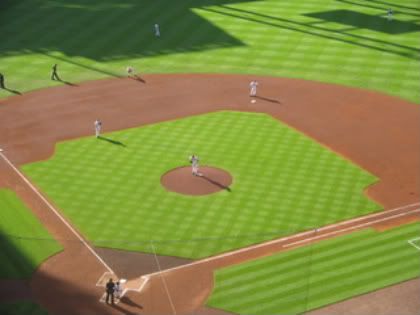
Baseball has a place in the American psyche like that of cricket in the English – or the Australian - psyche. Maybe it’s more like the Indian. In any case, baseball represents a purer more innocent America, of freckle-faced children playing scratch games in the parks and yards before Mom calls them home for pot roast and apple pie, which is why scandals like the Black Sox throwing the World Series, or the more recent steroid scandals have the power to shock a jaded population.

Baseball figures heavily in American art, literature and movies; the Blocksox scandal is referenced in The Great Gatsby. Two of the most successful baseball movies I can recall were Field of Dreams and The Natural. The latter film changed the downbeat ending of the original Bernard Malamud novel to a crowd-pleasing upbeat ending, which I and millions of others loved. The former has the reputation of a film that makes men cry. Both films tap into something more than just baseball stories: father-son relationships, chasing a dream, second chances and greater powers beyond our rational world. Field of Dreams makes me cry, but it’s the character played by Burt Lancaster that does it. Lancaster is a small-town doctor who lost his first chance to play the big leagues as a kid, and abandons his mystical second chance to save a little girl’s life. Kevin Costner’s character says to him of his missed opportunity, his five minutes in the Major Leagues, that some men would consider it a tragedy.  Lancaster replies ‘Son, if I had only gotten to be doctor for five minutes, now that would have been a tragedy’. That moment never fails to have me tearing up, even now as I write about it. My Dad, still alive and kicking, was a doctor and is a lifelong cricket fan and player, though he never threatened state or national selection. You would never mistake my Dad for Burt Lancaster, but the spirit of that line is one he would share.
Michael Chabon’s 2002 novel Summerland is an attempt to create a particularly American mythology based on mixing liberal doses of baseball with Native American and Norse mythology, and American folklore (and fakelore) aimed primarily at ‘young adults’.  A boy, the worst baseball player in his little league (I had a lot of sympathy with him), joins forces with a girl from his team, an American baseball-playing fairy, a werefox , a sasquatch, a giant and a wererat  - and others - to save his father and not one but three worlds from the destructive trickster Coyote. Even in that brief synopsis you can see the problem. Chabon tries to cram as much as he can into this long book but for me it never gels. The elements never quite mix and we are left with a lot of nice ideas, good characters and story elements that never coalesce into a satisfying whole. J R R Tolkein criticised C S Lewis for cramming too many mythologies carelessly into Narnia. If you can see the seams in Narnia, you can spot the fraying threads in Summerland.

Another major problem is baseball. A lot of the mythology Chabon creates centres on baseball but the game itself doesn’t have a function. A lot of baseball is played but little is achieved by doing so. At most, the plot depends on sidebets on the game.  I was reminded of Douglas Adams’ Life the Universe and Everything where it is revealed that cricket is a faint race memory of the most destructive war in the history of the universe, the Krikkitt Wars, and the climax of the book is a game of cricket that could destroy the universe.  In Summerland, the destruction of the universe is a sidebet on the final game. There is an incident that brings on the climax, but it’s contrived and unorganic, almost literally deux ex machina. The mythology is supposed to be centred on baseball but the baseball feels tacked on.

And despite Chabon’s lyrical description of the games, you need a fair bit of knowledge before you embark, of terminology, tactics and jargon. It is a mark of the cultural domination of the States that I know who Ty Cobb, Shoeless Joe Jackson, Babe Ruth and many other famous baseball players are, despite never watching a game of baseball. But my ignorance of the game is profound. I had to look up ‘designated hitter’ in Wikipedia to understand one of Chabon’s jokes. 

Neil Gaiman created an American mythology in American Gods, finding a spiritual equivalent of the history of the United States through old world and new world gods fighting it out in the American heartland. Gaiman too loves to fill his books with strands from many traditions of myth and legend but the end result is like one of those old picture puzzles, with faces and objects hidden among painstaking woodcuts of trees, mountains and skies. Chabon has given us a collage put together in haste.


  1. The book sold well in the States but I doubt it sold well anywhere else. I think if you believed in baseball like Chabon, and shared his knowledge of the game, you would find this book more enjoyable and more satisfying. Yet I loved both The Natural and Field of Dreams. Summerland, however, never gets beyond appealing to the baseball lover to find a wider audience.

Thursday, November 25, 2010

"What is the use of a book without pictures or conversations?" Comics books and reading

I used to think that I didn’t read comic books as a kid. But lately I remember that I did. I was never an avid collector but certainly I did read Caspar, Richie Rich and other Harvey titles, Archie, Mighty Mouse, a Tarzan comic which caused me to ask my mother what an upside-down ‘i’ meant – turned out to be an exclamation mark – and lots of Commando comics. Indeed, if you ever need to tell a German ‘hands up’, ‘hurry up’ ‘pay attention’ or to hurl mild profanities at him, I’m your man. As I got into my teens though, I tended to think of comics as kids’ stuff.

But in my thirties I started reading the giants of comic books, the Marvel and DC superheroes. I blame Lucas Stibbard, comic book collector, fellow actor and good friend of mine. In 2004, he pressed into my hand a copy of Michael Chabon’s The amazing adventures of Kavalier and Clay, a superb novel of two cousins, one American one Czech who, to cut a long story very short, create a comic book in what is now known as the Golden Age of comic books. This is the era of the creation of Superman, Batman and many other classic characters, around WWII. The picture of this time, and the comic book industry made me go and actually read some comic books.  I was quickly hooked. Luckily, local libraries now carry comic books because they are ruinously expensive to buy. That said, I now own Return of the Dark Knight and four volumes of The Essential Thor, so the collecting bug did not leave me unscathed.

The novel also led me to other Michael Chabon works, and the comic books led me to Neil Gaiman. Reading does that. Good writing leads you to look for more good writing. A reference in one book leads you to read another. Years ago I talked about comic books with Paul Galloway, now a playwright. He had also read the Harvey comics as a child. He said quite rightly that reading comic books is a good habit for your children because it gets them in the habit of reading.  I remembered this conversation while reading Kavalier and Clay, as it followed the historic campaigns that wanted to ban comics as ruining children’s minds.

DC comics have an historic edge over Marvel because they created the archetypes of superheroes: the man given super powers by some strange circumstance, in Superman; the man who trains his body and mind to superhuman levels, in Batman; and the female superhero, Wonder Woman. All superheroes, I suspect, are variations on these three. Not that Marvel would be too worried by my assessment. With Spider-Man, Iron Man, the Hulk, Wolverine, the X-Men, Thor, Captain America and others either filling or soon to fill the cinemas, they’re doing all right.

The superheroes themselves derive from older myths of gods and super-humans (not only does Marvel have Thor and the Norse pantheon on their side, they also have Hercules and the Greeks) and even precursors in popular culture. Lee Falk’s Phantom is a sunnier Batman with a healthy psyche and happy family life. But it was DC who turned these characters into a publishing phenomenon.

Nowadays, these heroes have such complicated back stories, relationships, and psychological issues, with different worlds, different universes, times, reboots and retrocons, that it may be difficult for the neophyte to get into them. In the main, I stick to the classics myself, the big names that I at least have some handle on. Looking up Wikipedia to find summaries is only more confusing. And never ask a comic nerd ‘Who’s this guy?” unless you have a good half-hour to spare.

The latest comic book I read is It’s a bird by Steven T Seagle and Teddy Kristiansen. Comic books, as well as becoming more expensive, have become much more sophisticated. No longer aimed at children, they have tended to grow older with their audience. This work is what may be termed a meta comic, or deconstructuralist, post-modern, or depost-something; it’s a comic book about writing a comic book. The protagonist, Steve, is a successful comic book writer who has been offered the big one – a Superman story. But he is reluctant for many reasons, not the least of which is that his first Superman comic was given to him while he sat in the hospital as his grandmother was dying.  His attempt to find meaning in the invulnerable man in red, blue and yellow tights in a 21st century modern world leads him down many creative and personal paths, some with dead ends.  This could have been awful, but the result is quite the opposite. It’s revealing, the artwork is excellent, and the story is gripping. Will Steven take what should be his dream job? And if he doesn’t, why not?

So while I still don’t read comic books on public transport, I’m happy to out myself as a comic book reader in conversation or online (it turns out). I don’t need to refer to them as graphic novels, no more than I need to get the adult dust covers for my Harry Potter books. Stories are one of the things that make us human, and if someone is telling me a good story, I don’t much mind the form in which they tell it.