Showing posts with label Story. Show all posts

Monday, December 7, 2015

"Real life? Or is this just fantasy?" The story of the stories of Santa.


I've always had a soft spot for Santa Claus. Heck, I know, we all do but for me it goes further than that. I was named after him, or more specifically, St Nicholas, and now, almost 46 years later, I'm fat and jolly.

Santa Claus, like Christmas itself, is a combination of history, Christian mythology and Pagan mythology. Generally speaking, stories, factual and legendary, of Nicholas, Bishop of Myra in the 4th century became mixed with Norse mythology, largely stories of Odin, and other traditions and stories, to create this jolly fat fellow in red and white with a big beard, who whips around the world in one night to bring all good children presents on Christmas Eve. He has been celebrated in song and stories,movies and books, and portrayed as elf, human, jolly, stern, and psychotic robot. The only thing missing is a gritty re-boot, although that can only be a matter of time. Odin's missing eye could come in handy.


There have been attempts to give Santa a backstory, one that explains the elves, the workshop, the red and white look, the reindeer, the gift giving, the stockings, and above all the magic. The first attempt that I knew of was one of Rankin and Bass' stop motion animation classics, Santa Claus is coming to town. There the story is told by Fred Astaire and Santa was voiced by Mickey Rooney.

I saw this annually for many years on TV and since TV now is not so helpful, I watch it on DVD every year. It's set in a Ruritanian country, and Kris, an orphan brought up by elves, defies the miserable rule of Burgermeister Meisterburger to bring gifts to the children of a small town. Eventually, with the help of a reformed Winter Warlock and others, he does the same to the world. It's a charming tale, one of the best of the Rankin Bass stable.

It was some years later I discovered they had gone to the well a second time with The Life and Adventures of Santa Claus, a much darker and more mythical approach. Indeed, some fifteen years separate the two films. There the Great Ak, Master Woodsman, with many other forest spirits and creatures, debate whether the man called Claus had done enough to earn the Mantle of Immortality. A baby abandoned in a magic forest becomes Claus, a skilled toymaker. Again he conceives the idea of spreading happiness with toys, helped by his adoptive faery and elven family. But this quest is actively opposed by certain forest spirits who will kill him if they can. This one was not considered as successful, although I found it striking on first viewing. When the credits told me it was based on the novel by L Frank Baum, he of the Oz books, I was determined to find it.

This was pre-internet days (yes children, there were such times) and obscure books were difficult to find. Many years later I did find a copy in a second-hand bookstore. Sadly, I found it more in the vein of Baum's lesser Oz books, episodic, lacking a strong drive, and Claus is not the main mover in removing the threats to him or achieving his dreams, and so becomes a passive character. I have not seen the TV special for a long time, but I remember it as better. Perhaps I am wrong. I should get hold of it too. There is a more recent 2D animation, but it is not very good, although it did hold the attention of my  seven-year-old niece nicely.

More recently, Jeff Guinn attempted to bring the stories of Nicholas of Myra together with fables of Santa to write theThe Autobiography of Santa Claus. It's an admirable attempt to marry history and myth into a coherent whole but for me it was bit earnest and a teeny bit dull - it lacked magic.


This year has seen a wonderful addition to the ranks,  A boy called Christmas, by Matt Haig. While it hits many of the same points, elves, reindeer, presents, stockings etc it does so in a charming, off-beat and irreverent way, and the story as a whole has unexpected, fresh rhythm. 


You may wonder how I know the true story of Father Christmas and I will tell you you shouldn't question such things. Not right at the start of a book. It's rude, for one thing. All you need to understand is that I do know the story of Father Christmas, or why else would I be writing it? 


Nikolas, born on Christmas day, is the son of a woodcutter in Finland, whose only two Christmas presents ever have been a sleigh and a doll made out of a turnip. When his father joins an ambitious group looking for proof of elves up in Lapland, Nikolas is left in the care of his deeply unpleasant aunt Carlotta, and, as you might say, adventure ensues.

This is not a twee, nor even a safe story. Nikolas and the other characters he meets on the way are in genuine danger, and death and exploding heads can ensue. But through it all is the thread of belief in magic, and believing though you've never seen it, like a mouse can believe in cheese, even if he's never seen cheese. The illustrations by Chris Mould are fun and charming, and occasionally help to push the story along, or at least explicate a point otherwise glossed over. There's even some reindeer poo and wee jokes, if you like that sort of thing - and who doesn't? And in the end, it all boils down to the joy of giving.

I think this would make a lovely gift, and would be excellent book to be read aloud. I think you should get in quick before it becomes a classic book everyone knows. And available in bookstores right now!


SaveSave

Thursday, December 30, 2010

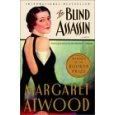
"But let a woman in your life..." The Blind Assasin

A little while ago, there was a Facebook thing (I don’t know what else you call them) asking people to name their fifteen favourite/most influential writers. I posted mine and a female friend (I use friend here in the sense of someone I actually talk to, visit etc rather than a Facebook Friend) observed of mine, “You need to read more female authors.”

All fifteen of mine were male. True, Lee Harper was a writer who popped to mind moments after I posted the list and in the days following I remembered some female writers I had read (e.g. Jane Austen, E. Annie Proulx, Enid Blyton, Ayn Rand (urgh!)) but in all honesty, there are not that many female writers whose work I follow. My friend sent me a list of writers to check out. The name that struck me strongest was Margaret Atwood, an author who is on my list of ‘I really must read … one day’. So the day had arrived and I dutifully (if eventually) took to the library to borrow a Margaret Atwood novel.

The one I chose was The Blind Assassin. I loved the title and the cover, a 1930s advertising portrait of a woman. The book starts with the death of Laura Chase, the author of ‘The Blind Assassin”. Laura’s book is the story of a man and a woman, secret lovers, always on the move. Why they are on the move is a mystery and he tells her science fiction stories that he later writes up for pulp fiction magazines. ‘The Blind Assassin’ has stories within the story that is within The Blind Assassin. Along with excerpts from Laura’s book, we get newspaper accounts of tragedies befalling a family, and the memoirs of Laura’s older sister Iris, writing in modern times. As Atwood’s book continues, all these strands come together in a satisfying and moving way.

I really enjoyed this book. I followed my pattern of reading books I love by devouring early chapters, and lingering over the last few, avoiding reading the book so I would not finish it so quickly. As the book draws to a close, you may find yourself flipping back to the beginning, as I did, looking for what you missed the first time. My description of the book may make is sound difficult, but it is immensely simple and pleasurable to read.

I don’t know why I haven’t read more female authors.  There was a time when there were fewer around but that was sometime ago, and today they are legion. I've never avoided a book because it was written by a woman, and I'm sure there are books I've read of which I cannot recall the sex of the author. I did read a few books by women that re-imagined classic female characters e.g. Rebecca, Morgana le Fay and Medea. All these books turned these diverse characters into the one: a sexually- confident, liberated, very modern woman. It was as if we re-imagined Hamlet, Beowulf or David Copperfield as a sexually confident, liberated and very modern man: unlikely and dull.

Still, the failings of a few authors working in one genre should not have put me off the entire gender. I do have a hard time picking up modern novels by anyone, worried that they will be all technique and no story. And many books do appeal to one sex over another. I discussed my failure to get through Madame Bovary with this same female friend and she said, “I think that’s more of a woman’s book.”

So why I have this curious failing is open to discussion, if you are so inclined. In the meantime, Sophie, I am hooked on Margaret Atwood; The Handmaid’s Tale will be my next one, I think.

Wednesday, December 8, 2010

"What is a man but his old stories?" Roddy Doyle's Henry Smart trilogy

The other day, I read in The Age one commentator describe the current Irish financial crisis as a betrayal of the men who fought for the Republic. There is very little in Irish history that isn’t.  The cool winds of Ireland are not produced by differences in air pressure over different parts of the earth’s surface but by the untold millions of betrayed men spinning in their graves.

I don’t mean to sound cynical; Ireland’s history to me has always seemed astonishingly sad. The sadness derives from the cyclical nature of the violence and tragedy; men risking their lives left waiting on beaches for promised support that never comes, again and again; children being indoctrinated to share their parents’ hatred; the country finally winning some independence in the Anglo-Irish War then turning on itself in civil war; people imagining that this time, this violence, this shooting, this bomb will change things, that this promise, this assurance, this treaty will bring peace.

Nor do I want to romanticise it. The bombings, the shootings were all too often pointless, petty, motivated not by high ideals but by a lust for money, power or violence for its own sake. At long last, peace may well be coming to Ireland. Bombings still happen, but not nearly with the frequency they once did. (The Irish always maintained a sense of humour: a shop in Belfast that lost its front kept in business and put up a sign ‘More open than usual’.) In the long contest between the bullet and the ballot box, the ballot box has won, as it usually does – but the bullets keep coming.

If you want to read about the Irish experience of the 20th and 21st centuries, you could do a lot worse than starting with Roddy Doyle’s wonderful The Last Roundup trilogy: A Star Called Henry (1999), Oh, Play That Thing (2004) and The Dead Republic (2010). The three novels tell the story of Henry Smart from his birth in Dublin in 1901 through to his old age in 2010. Born into a world of poverty and violence, he never entirely escapes it. Even as a child, his eyes have a force than intimidates men and attracts women. In the first book, he survives a miserable Irish childhood to fight the Easter Rebellion, the Anglo-Irish War, the Civil War, and marries before he has to flee the country, just ahead of his former allies.  In the second, he finds England isn’t far enough and runs again to America where he falls foul of a whole new type of gunman. There he also has jazz, bootlegging, American-style evangelism, and the Depression to occupy him before middle-age takes him in the third book back to Ireland where his past and Ireland’s are still waiting for him.

He brushes against some big names - that’s his elbow in the photo of de Valera under arrest.  He works with people such as Michael Collins, John Wayne and in Oh, Play That Thing, he works for a very young Louis Armstrong, before the jazzman even has the nickname Satchmo. James Connolly teaches him to read. Gerry Adams wants to be seen shaking his hand. John Ford wants to make his story and makes The Quiet Man instead. This is not Forrest Gump reassuring us everything is fine. We keep being reminded of what’s going on behind, or underneath, the stories we know, the violence, the money, the ideals, the deals, the sweat, the blood, the dreams, the sex, the whim of chance and the drive of fear. 

These are rich, entertaining, novels, full of humour, great characters, incident, and dialogue. Henry’s wife, Miss O’Shea, could carry a novel herself.  I actually gasped out loud during moments (I’m not much of a one for gasping.) Some characters are created in a dash of words, and can disappear in fewer, yet stay with you, like they stay with Henry. Doyle’s language is a pleasure to read and he is a wonderful storyteller. I found myself reaching for this novel even if I only had five minutes to spare. Then as they drew to a close, I would try to make the remaining pages last as long as I could. This is a subversive look at Irish history, driven by a great love story.

It is also a story about stories. Henry is made and trapped by his own story, even the bits that aren’t true, even the parts he made up.  The stories he knows about other people make him a hero and a target. He and his missing wife (or is he the one missing?) track each other by the stories they tell and hear. He and John Ford fight over how to tell his story to an American audience, through a Hollywood film. The fight for Ireland may well simply be a fight for the story of Ireland, how it is told, and who gets to tell it. And stories are nothing without an audience. This is where you and I come in.

All the strands of Henry Smart’s long life tie together beautifully by the end of the third novel. I could not say if each book stands alone as I read them in order within a few months of each other.  I would urge you to read them in order too, although there's no need to rush – they were published over eleven years. The humour, vitality and sadness of Irish history are here and Henry Smart is a memorable entertaining narrator. His brother Victor will haunt me for a long time.

Thursday, November 25, 2010

"What is the use of a book without pictures or conversations?" Comics books and reading

I used to think that I didn’t read comic books as a kid. But lately I remember that I did. I was never an avid collector but certainly I did read Caspar, Richie Rich and other Harvey titles, Archie, Mighty Mouse, a Tarzan comic which caused me to ask my mother what an upside-down ‘i’ meant – turned out to be an exclamation mark – and lots of Commando comics. Indeed, if you ever need to tell a German ‘hands up’, ‘hurry up’ ‘pay attention’ or to hurl mild profanities at him, I’m your man. As I got into my teens though, I tended to think of comics as kids’ stuff.

But in my thirties I started reading the giants of comic books, the Marvel and DC superheroes. I blame Lucas Stibbard, comic book collector, fellow actor and good friend of mine. In 2004, he pressed into my hand a copy of Michael Chabon’s The amazing adventures of Kavalier and Clay, a superb novel of two cousins, one American one Czech who, to cut a long story very short, create a comic book in what is now known as the Golden Age of comic books. This is the era of the creation of Superman, Batman and many other classic characters, around WWII. The picture of this time, and the comic book industry made me go and actually read some comic books.  I was quickly hooked. Luckily, local libraries now carry comic books because they are ruinously expensive to buy. That said, I now own Return of the Dark Knight and four volumes of The Essential Thor, so the collecting bug did not leave me unscathed.

The novel also led me to other Michael Chabon works, and the comic books led me to Neil Gaiman. Reading does that. Good writing leads you to look for more good writing. A reference in one book leads you to read another. Years ago I talked about comic books with Paul Galloway, now a playwright. He had also read the Harvey comics as a child. He said quite rightly that reading comic books is a good habit for your children because it gets them in the habit of reading.  I remembered this conversation while reading Kavalier and Clay, as it followed the historic campaigns that wanted to ban comics as ruining children’s minds.

DC comics have an historic edge over Marvel because they created the archetypes of superheroes: the man given super powers by some strange circumstance, in Superman; the man who trains his body and mind to superhuman levels, in Batman; and the female superhero, Wonder Woman. All superheroes, I suspect, are variations on these three. Not that Marvel would be too worried by my assessment. With Spider-Man, Iron Man, the Hulk, Wolverine, the X-Men, Thor, Captain America and others either filling or soon to fill the cinemas, they’re doing all right.

The superheroes themselves derive from older myths of gods and super-humans (not only does Marvel have Thor and the Norse pantheon on their side, they also have Hercules and the Greeks) and even precursors in popular culture. Lee Falk’s Phantom is a sunnier Batman with a healthy psyche and happy family life. But it was DC who turned these characters into a publishing phenomenon.

Nowadays, these heroes have such complicated back stories, relationships, and psychological issues, with different worlds, different universes, times, reboots and retrocons, that it may be difficult for the neophyte to get into them. In the main, I stick to the classics myself, the big names that I at least have some handle on. Looking up Wikipedia to find summaries is only more confusing. And never ask a comic nerd ‘Who’s this guy?” unless you have a good half-hour to spare.

The latest comic book I read is It’s a bird by Steven T Seagle and Teddy Kristiansen. Comic books, as well as becoming more expensive, have become much more sophisticated. No longer aimed at children, they have tended to grow older with their audience. This work is what may be termed a meta comic, or deconstructuralist, post-modern, or depost-something; it’s a comic book about writing a comic book. The protagonist, Steve, is a successful comic book writer who has been offered the big one – a Superman story. But he is reluctant for many reasons, not the least of which is that his first Superman comic was given to him while he sat in the hospital as his grandmother was dying.  His attempt to find meaning in the invulnerable man in red, blue and yellow tights in a 21st century modern world leads him down many creative and personal paths, some with dead ends.  This could have been awful, but the result is quite the opposite. It’s revealing, the artwork is excellent, and the story is gripping. Will Steven take what should be his dream job? And if he doesn’t, why not?

So while I still don’t read comic books on public transport, I’m happy to out myself as a comic book reader in conversation or online (it turns out). I don’t need to refer to them as graphic novels, no more than I need to get the adult dust covers for my Harry Potter books. Stories are one of the things that make us human, and if someone is telling me a good story, I don’t much mind the form in which they tell it.