Sunday, December 9, 2012

"That wraps it up!": The Shroud of Turin

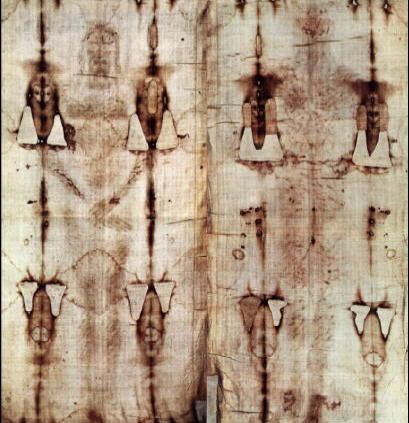
Many years ago, I read a book by an American scientist, an atheist, who was one of an international team of scientists who were given unprecedented access to the Shroud of Turin by the Catholic Church for means of examination and scientific testing. The one test they were not permitted was carbon-dating, as this process destroys what you are testing.

The conclusions of the team were that the figure on the Shroud was formed by blood, contained pollen and dirt consistent with a Middle-Eastern origin, and showed a man who had been whipped with first-century Roman whips, and then crucified and had wounds on his his head consistent with sharp thorns. In short, as far as could be tested, everything showed it to be what it claimed to be: the burial shroud of a man from the Middle East crucified in the first century in same way as Jesus. Beyond that, they could not say more.

The Shroud of Turin, whatever else it is, is a mysterious object. If fake, then how was it done? If real, many more questions arise. But no-one had heard of it until the Middle Ages, and modern carbon testing has declared it a Medieval fake. So much for that.

Ian Wilson is an historian who has been examining the Shroud and historical evidence of the Bible for some time, with many books and television documentaries to his name. In his 2010 book, The Shroud: The 2000-year-old mystery solved he claims to have solved both the major objections to the authenticity of the Shroud. It is, to say the least, a bold claim.

He only spends one chapter on the Carbon Testing, which seems a little slight, but then he can only raise two objections. One, that mistakes happen and other carbon tests have been subsequently found to be way out. But this leads to his more interesting objections: these mistakes have often been due to contamination of the material being tested. The Shroud has been burned, soaked in water, repaired, displayed in front of burning candles and is anything from 700 to 2000 years old, most of that time not nearly as protected as it has been recently. Mmmmmm. Moreover, the strips that were cut for testing were taken from the upper-left corner. For many years, when the Shroud was displayed much more often than it is today, it was held up by clerics, with one at each corner, and on or two in the middle. This corner therefore was one of the most contaminated areas of the Shroud, filled with generations of dirt and sweat and skin cells. It was the area most likely to return a false result. Which then raises the question, why choose it?Short of letting another part of the Shroud being destroyed for more testing, speculation is all that is left for those who want to believe.

But as I say, this is only one chapter. Wilson spends most of the book on the other main objection: if it is real, then where was it for the first 1400 years of its existence? His answer for this is to link the Shroud to another mysterious image of Jesus on cloth that disappeared some decades before the Shroud appeared,the Image of Edessa.

Yes, I'd not heard of it either. But accounts of it date back to the 1st century to the town of Edessa, now called Sanliurfa, in modern Turkey, where it was kept from around 30AD to 944AD. Its history, and journey thereafter, are quite complicated, and rather than summarise, I would direct you to the book. 

But unlike the objections to the Carbon Dating, this is far more convincing and thorough, even to the point of tediousness. There is much speculation and supposition, as you would expect on any object from the 1st century, but Wilson makes as good a case as he can be done. It would be more convincing, but for the carbon testing.

Leonardo action figure: coming soon!
But even if you don't believe in the Shroud as the burial cloth of Jesus, there are still questions that have to be answered. Why did other scientific testing, finding blood and other materials, tend to prove it authentic? Why did a Medieval artist choose to do an anatomically correct crucifixion when no-one, no-one, else depicted it that way? And finally, how was it done? Despite many efforts, no-one has been able to recreated a Shroud in any way that is believable or practical. Leonardo da Vinci has been mentioned of course, but the Shroud, even as a fake object, existed before he did. (One wonders how Leonardo found time to do anything with all the conspiracies he up to his hips in.) Even as a fake, the Shroud still poses questions for which we cannot find answers.

Saturday, October 13, 2012

"Quis custodiet ipsos custodes?" John Le Carre's world


John le Carre’s name is always associated with a specific genre, the spy novel. But this has not stopped him from writing some of the great novels of the twentieth century. Given he was writing about one of the great facts of the twentieth century, the cold War, the clash between civilisations, the West, the Communists, the Terrorists, his books give an insight and ponder they way we were living in that era – and indeed, still live.

His greatest creation is undoubtedly George Smiley. Fat, short, old, academic, intellectual, and cuckolded he is indeed the anti-Bond. But as a Bond novel or a movie is an entertainment for a few hours, time spent with Smiley is time spent considering the nature of our society, its flaws, its strengths and what we will do to defend it, or what we will not do. Which are not ideas that evaporate quickly.

While le Carre’s plots are byzantine, the power of his novels come from what Graham Greene, in one of his spy novels, called the human factor. Who are these people who put themselves on a shadowy front line, commit themselves to a life which means that they can never be truly secure even in their own home, or competely honest with anyone? Which is why a story like Tinker Tailor Soldier Spy can be re-read even when you know already who that spy is. Le Carre loves watching the watchers, and he shares that fascination with us.

I have recently re-read what is known as the Karla trilogy (aka The Quest for Karla or in its latest incarnation Smiley versus Karla): Tinker Tailor Soldier Spy, The Honourable Schoolboy and Smiley’s People. The first is easy found in bookstores and libraries due to the recent, very good film. The latter two it seems are either found in second-hand bookstores or in bulky volumes carrying all three novels.
I borrowed one of these from my local library, and it has two disadvantages. One, its bulk makes it uncomfortable to read on the couch or in bed, and too large to sit in your backpack all day if you want to make it your commute read. Secondly, one feels compelled to read them through one after the other which may become like having too much of anything, slightly sickening and leaves one, as Basil Fawly remarked, wanting less. This compulsion is exacerbated when you have access to the book for only three weeks.

Luckily, I was only reading two novels, and the tone changes between both. The Honourable Schoolboy ranges from London to Hong Kong and is mainly concerned with Jerry Westerby who is a part-time agent chosen by Smiley to follow a lead of Karla’s money being funnelled to a Hong Kong bank.  (Le Carre has said it would have been a better story if he had not made it a Smiley novel. Perhaps he is right.) Smiley’s People is a more intimate story, Smiley following up on the murder of an old agent, which leads to his second direct confrontation with his nemesis Karla. It does form a satisfying trilogy, all the more so because Karla remains unknowable, even to Smiley, and so the strongest conflicts remain those between friends and colleagues.

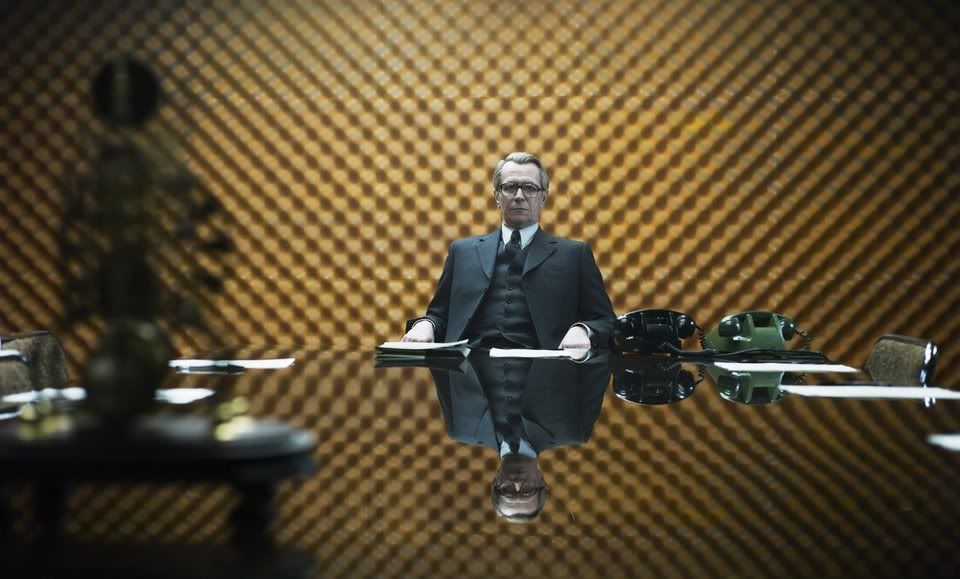
In the 70s, the BBC televised Tinker Tailor and Smiley’s People, but The Honourable Schoolboy was too expensive to film, and though important was not essential to the duel between Smiley and Karla. The producers of 2011’s Tinker Tailor look like going down the same route. And I have to say, Alec Guiness is still the essential Smiley to me. While Gary Oldman gave a great performance, physically he is all wrong. Still I don’t suppose this keeps him or his producers up at night.

Le Carre’s novels revel in the moral murkiness of espionage, where the good man may have to do bad things for a noble purpose. And ultimately that man’s soul is a casualty of the conflict. In The Honourable Schoolboy, Smiley states his faith:

          To be inhuman in defence of our humanity he had said, harsh in our defense 
          of compassion. To be single-minded in defense of our disparity.  
  
His political masters find this distasteful, and it contributes to his precarious position within the Secret Service. But if we can conjure with the idea of a just war, we may have to accept this as part of the price we pay for our freedom. And hope that there is always someone else who is prepared to pay it.

Friday, September 14, 2012

"Land it on a sixpence" Cricket and money


Cricket, test cricket, that is, is a game that engenders speculation and philosophy. It takes five days, has lunch and tea breaks and most of the action takes place a long way from you sitting on the boundary. Even if you’re playing, standing in the field gives you time to think. It’s a game of nuance: a bowler manages a maiden over, and the advantage has passed to the bowling team. By the same token, a batsman surviving such an over may have given the advantage to his team. And as such, it also engenders, for mine, the finest sport writing. Not that boxing, football and other faster paced sports haven’t resulted in good writing, but a good cricket book is something special. My favourite contemporary cricket writer is Melbourne-based journalist Gideon Haigh. His books are witty, informed, and driven by a love of the game.

Sphere of influence: writings on cricket and its discontents is a 2010 collection of essays, speeches, and articles Haigh has written for such sources as Cricinfo, The Monthly, The Spectator, Sports Illustrated India and The Age. The major theme of these articles is the rise of the India to the economic centre of international cricket, the ineffectualness of the ICC, and Twenty20 and its effect on the sport. These are all entwined issues.

Twenty20 is a great money-maker for the game, particularly India, where an entrepreneur took an English concept and made it into an Indian powerhouse. Other nations have followed suit, with less success. Twenty20 may yet be a dazzling flash in the pan, but India has bet its future on it, eschewing test cricket which is the ultimate test of a player’s talents and strengths. India has been the No 1 test nation in the world (although the method of determining that, as Haigh says, is obscure and complicated at best) but in its last tour of Australia was an example of diminishing returns.

The other problem with the tidal wave of money now engulfing cricketers is its almost inevitable handmaiden, corruption. Match-fixing was a blight on the game in the 1990s. Now we have spot fixing, no-balls at particular time and so on. Pakistan players were guilty in this instance. Poorly paid, other countries unwilling to tour their troubled country, banned from the riches of the IPL by India, is it any wonder that some of them were happy to take money wherever they could get it? Dodgy administrators and administrations, a powerless and petty ICC, ruthless and powerful gambling interests; is it any wonder the Haigh senses an approaching crisis? He poses a very pertinent question: does cricket make money in order to exist, or does it exist in order to make money? He thinks it should be the former, he fears too interested parties are starting to think the latter. And the consequences of that for those who love the game are worrying indeed.

And I see in my own profession signs that there are those who are moving the bottom line from an important consideration to the main consideration. One theatre director, convinced that ‘bums on seats’ should be the major driver, programmed ‘popular’ shows and almost took his theatre company to the wall. A university changed the Department of Arts to the Department of Creative Industries. It said it was a hard-nosed recognition of the nature of arts and the importance of knowing how to make money with it. Somehow, departments of Medicine, Science, Engineering, Law and Architecture, have never considered how to make money using their knowledge, nor recognised that at some point they would need to. To me it was a buzzword approach that signified the ultimate surrender of Art to Money.

If cricket and theatre are simply tools to make money, then we play and watch cricket for the same reason we play and watch theatre. And having done both, to lesser and greater effect, I can tell you we don’t. The play, and the day’s play, still need to remain the thing.

Friday, August 31, 2012

"It's the cover-up." Nixon in the White House.


I think I’ve read more books about Richard Nixon than Abraham Lincoln, which is a bit odd. Lincoln is often thought to be the greatest President, Nixon the worst. Certainly Nixon is the only President forced from office due to the criminal activities exposed by the press and his political opponents. He was paranoid, regularly lied to the press, to the people, to allies, to the Congress and anyone else when it suited him and assumed everyone else was doing the same. He dragged out the war in Indo-China, expanding it to other countries while claiming to work for peace. He was introverted and severely reduced the number of people who could contact him directly. He had ‘anecdotalists’ follow him around to spread stories that showed his warm side. He was without a doubt the strangest man ever to be POTUS.

On the other hand, he was a visionary, who created new relationships with China and the USSR. Some of his domestic reforms are still praised. After finally getting an end to the Vietnam War, it was rumoured he was to be nominated for the Nobel Peace Prize. He told his aides to withdraw the nomination: creating peace was his job. (Perhaps his conscience troubled him. In any case, I wish a more recent President had similar integrity in this area at least.) After his departure, he was able to recreate himself as an older statesmen with great knowledge of international politics, a reputation that was deserved.

President Nixon: Alone in the White House by Richard Reeves is an almost day by day account of the Nixon administration and gives a compelling picture of both the nature of that Administration and its head. It was a different White House. A shy introverted man, Nixon used Haldeman to keep people away from him, and received other’s advice on paper, encouraging, up to a point, those who were prepared to challenge his thinking. One of the few men allowed to talk to him was Henry Kissinger. Their relationship was difficult, both intelligent men with clashing personalities and egos. Yet between them they redrew international relations in the midst of the Cold War, an astonishing accomplishment by any standard.

The illegal activities that ultimately brought him down were in place almost from the beginning. On tape, with other people, he was crass, aggressive and stuttering. On paper, on his own, he was thoughtful, visionary and continually trying to improve as a man and a president. He wanted to revive the fortunes of the USA, and the prestige of the office. In the end, he seriously damaged both.

Oddly, he neither authorised nor was aware of the Watergate break-in until three days after it happened. If he had then turned his people in, he could have survived. Out of an odd sense of personal loyalty, he chose to cover up their activities instead, with well-known consequences. The major problem I had with this book was that it ends with Haldeman and Erlichman’s resignation, with Nixon’s own some fifteen months in the future. It struck me as a rather arbitrary place to stop.

Richard Nixon was a man of contradiction, brought down by his own demons and shortcomings. Had he listened to the better angels of his nature, who knows what he would have done, and how he would be remembered. 

Thursday, July 12, 2012

"Father and son." Henry IV and V


Our picture of the English kings from Richard II to Richard II (which includes Henrys IV. V and VI and Edward IV) is largely shaped by Shakespeare’s plays. Thus we have the evil Richard III, the saintly but ineffectual Henry VI, the romantic if hopeless Richard II, the warrior-playboy Edward IV and the glorious Henry V. But Henry IV is oddly elusive despite appearing in three of the plays, two of which bear his name. As Bolingbroke he seems to have no inner life as he moves remorselessly to the crown. As king, he is always on guard, facing rebellions from within and without England, and even within his own family. It is not a role that attracts the great actors, and is overshadowed by Prince Hal, Hotspur and that great glorious force of life Falstaff.

But both Henry IV and V may well have been unfairly treated by Shakespeare. (And let’s not get into Richard III.) Henry IV overthrew a tyrant to the general acclaim of his countrymen, and through tenacity, courage, military prowess and mercy, left his son a secure throne, and set England on the path to Constitutional Monarchy. Henry V was both a religious hypocrite and fantatic, not afraid to go to war in the name of God and sacrifice common men to secure his own glory. So argues Ian Mortimer in his two books The fears of Henry IV: the life of Engand’s self-made king, and 1415: Henry V’s year of glory.

Mortimer, as I’ve mentioned before, writes exciting readable histories, and is not afraid to be inconclastic without being gratuitious. His books are well-researched and well-argued. Henry Bolingbroke is a rounded believeable character, far-removed from the politic and guilt-ridden character in the plays. His relastionship with his two wives, his problematical relationship with his eldest son, and his relationship with the lords and powerful of his time are all brought to life in fascinating detail.

The fears of Henry IV is a conventional biography in form, while 1415 takes a very different approach. He studies wills, diaries, letters, account books and other sources to create an almost day-by-day look at this crucial year. Sometimes this can became, I found, a little tedious but on the other hand it serves to bring the era to life in compelling detail. The Henry of this book is colder, more machievellian than Shakespeare’s, while still being a great king and warrior.

Mind you, Shakespeare’s Henry V, on a close reading, is not quite the straightforward hero of popular thought. Through the characters of Pistol, Nym, Bardolph, as well as Fluellen and Williams, we see the king as a powerful man who uses the little people as a tool on his way to glory. The ghost of the rejected Falstaff lurks nearby, and makes us query this man’s actions and rhetoric. Harry is a great king, but a great king is not necessarily a great man.

Having recently played in a production of Henry IV 1, which prompted me to read both these books, I wonder at Shakespeare’s great design of his plays. Shakespeare, I have no doubt, wrote on the fly, without too much revision or planning. But still, having written the plays covering the War of the Roses, he was then prompted to go back and write the story of the lead-up, from the deposition of Richard II. I wonder now if Shakespeare, as a loyal subject of Elizabeth I, didn’t see the deposition of Richard, the annointed monarch, as a great sin, that in almost Greek fashion could only be extirpated by the death of all involved, whether that involvement was their own or their family’s. Only when all the Plantagenants were dead could true peace return to the realm. It’s an attractive theory, attractive in the sense that it can never be disproved. But ‘tis mine, and I will have it.

Wednesday, July 11, 2012

"None so blind." AIDS and America


I don’t often have visceral reactions to book. Sure they can make me laugh, make me cry, but until I read  And the band played on: Politics, people and the AIDS crisis, I’ve never thrown up in my mouth a little. And it wasn’t the revelation of various more extreme gay sexual practices (which oddly I seem to have been largely aware of) or the descriptions of the diseases that suddenly were infecting young men with horrific results, nor the horrid hatred that was revealed against gays. No, it was the reaction of a bathhouse owner to the threat of closure.  For those of you not in the know, the bathhouses were places where gay men would have multiple anonymous partners, and as such were one of the hubs of the American AIDS crisis. One of the owners turned to a doctor after a meeting and said, “What do you care? We make money when they come here, you make money when they get sick.” Another said, “There is no evidence that AIDS is a sexually transmitted disease.” Togther, they made the bile, or something, rise to the back of my throat.

The AIDS epidemic, as author Randy Shilts, says, didn’t happen to America, it was allowed to happen. Between “not inflaming the homophobics while not offending the gays”, government indifference, from all levels and all parties, scientists arguing over funding and credit rather than doing research, and gay activists more worried over their civil right to anonymous multiple partners than the lives of others, AIDS got a grip in America in a way that could easily have been, if not avoided, certainly minimised. It’s a book that will make you angry and saddened.

At the same time, you meet men and women, gay and straight, who were not afraid to tell the truth, to take on the problems of trying to deal with a disease that was either being ignored or denied, working with little or no support, inadequate or no funds, watching friends, loved ones, patients dying around them, fighting in the political, social, economic, and scientific arenas. Some of them ended up with the disease themselves but kept going. Some of the good guys are unexpected. For example C Everett Koop, a Reagan-appointed fundamentalist Christian, was the Surgeon General who treated AIDS as a public health issue, rather than a moral or social issue. It was late but it was something.

Some of the people are inspiring, some infuriating, some touching, some more ambivalent. The infamous Patient Zero, Gaetan Dugas, deliberately was having sex without telling his partners he had the disease or taking any precautions. And yet, while he angers with his actions, he comes across sometimes as a tragic figure, tormented by chance and his personal demons. Although Shilts has been accused of creating a gay bogeyman in Dugas, I thought his portrayal was compassionate without losing sight of Dugas’s role.

The book covers the year 1980 to 1985 in detail, culminating in Rock Hudson’s announcement of his disease, when AIDS finally became part of the public discussion. Apart from the social and political story, it is also fascinating to read how a new disease is recognised, found, defined and isolated. And for a book full of science, technical terms, and government departments and acronyms, it’s quite the page turner. Its believed AIDS arrived in the US in 1976 with the Bicentennial celebrations. Before then it was already in Africa and France. Only in America, because of how it first presented, did it become known as the gay disease, with disasterous consequences worldwide. Shilts was the only journalist to follow the story from the beginning, and was uniquely placed to write this book. We should be grateful he did.

There is still no cure for AIDS, only treatments. As more young gay men, as I am told, are thinking AIDS is no longer a threat, this book may still be timely reading.

Saturday, June 2, 2012

"Mon panache." Cyrano de Bergerac and history.


Anyone who has read Shakespeare’s Richard III and then done some research quickly realises that the play and history don’t have all that much in common. And that’s fine. Shakespeare was above all a man of the theatre who knew what sold, and if the play itself is a bit clunky and long, the character of Richard is always a favourite with audiences, whether he’s medieval and silky like Olivier, gothic and spidery like Sher or modern and slick like Ewen Leslie in MTC’s 2010 production.

Cyrnano de Bergerac is another historical character best known for the play losely based on his life rather than for himself.  Ishbel Addeyman has made an effort to change all that with her 2010 book, Cyrano: The life and legend of Cyrano de Bergerac. She insists that the real Cyrano is even more fascinating than the character. Sadly, she never quites proves it.

Not that Cyrano is without interest. He was a skilled swordsman, and did indeed fight 100 men at once. So the story at the time had it, even if there was no proof of it beyond nine hats lost by the attackers. Still, even if it was one against nine, that’s still a good effort tough to equal. He was a writer and satirist, inventing science fiction, parodying 17th century French society with his tales of journeys to the Moon and to the Sun and the people he finds there. He had enemies who in the end murdered him – all by the age of thirty-six.

Addeyman goes further than the legend.  His cousin Roxanne was older than he, and it seems of no romantic interest. Indeed, Addyman thinks it likely that he was gay, with intense friendships and fight with certain male friends as her evidence. Certainly it seems he was never involved in a great heterosexual romance so who knows. It certainly would have made him even more an outsider in his society.

As did his atheism. At the time atheism was as daring and dangerous as some people seem to think it is now.  But she harms this finding by the sheer weight she puts on it. Having establlished this fact, she cannot leave it alone. Everything leads back to his atheism. In one chapter she starts talking about a mystery wound he has. This only holds her interest for a few pages before she’s back to his atheism. Too much of this book feels like filler and much of this filler is this.  She even claims the Jesuits killed him. Not with any evidence or anything, but he was atheist and Jesuits get up to stuff so you know, it stands to reason.

Which is a pity. There is some good stuff on the role of duelling in France and Cyrano’s attitude towards it, and violence as his life went on. His literary fights with his rivals are also good. He had difficult relations with his family, and would change his name to create a more aristocratic background than his suburban Parisian one.  Towards the end, he did indeed find a patron; one that abandoned him after the attack that wounded and eventually killed Cyrano. And he was proud of his large nose. All his portraits show him posing at an angle that emphasised it. I would have liked to read more about the man and less about the one, admittedly interesting aspect of him, that of his religious beliefs or lack thereof. But perhaps she has the same challenge that Shakespeare’s biographers have – there just isn’t that much material. Le Bret wrote a biography and there is his own writing and letters, but the rest is supposition and inference. Addyman may rely too much on this for mine.

She also makes one odd, glaring error. One of Cyrano’s pet hates was plagiarism, and so she thinks it is ironic that his fame rests on a play based on plagiarism. Cyrano giving Christian his lines to speak to Roxanne is not plagiarism, it’s playwrighting. She seems unsure of the meaning of ‘irony’ and ‘plagiarism’. Mind you, as Brisbane friends know, she’s not alone. However, she’s on stronger ground when she reveals that the play itself was banned from the US for fifty years, on charges of plagiarism. Rostand had read a play with the central device of the friend giving another his lines to woo a woman. His play was better but the charge stuck. And yes, Moliere did steal the“what the devil was he doing there?” scene lock stock and barrel from Cyrano.

But in the end, this is a rather dull book, which is a pity. The historical Cyrano and his writing do deserve to be better known than they are. But in the meanwhile, we could all do a lot worse than be commemorated in such a romantic, glorious, tragic play.